
Revenue vs. Profit: What Small Business Owners Need to Know
Understand revenue vs. profit, how gross and net profit differ, and why small businesses should track expenses, margins, and cash flow.
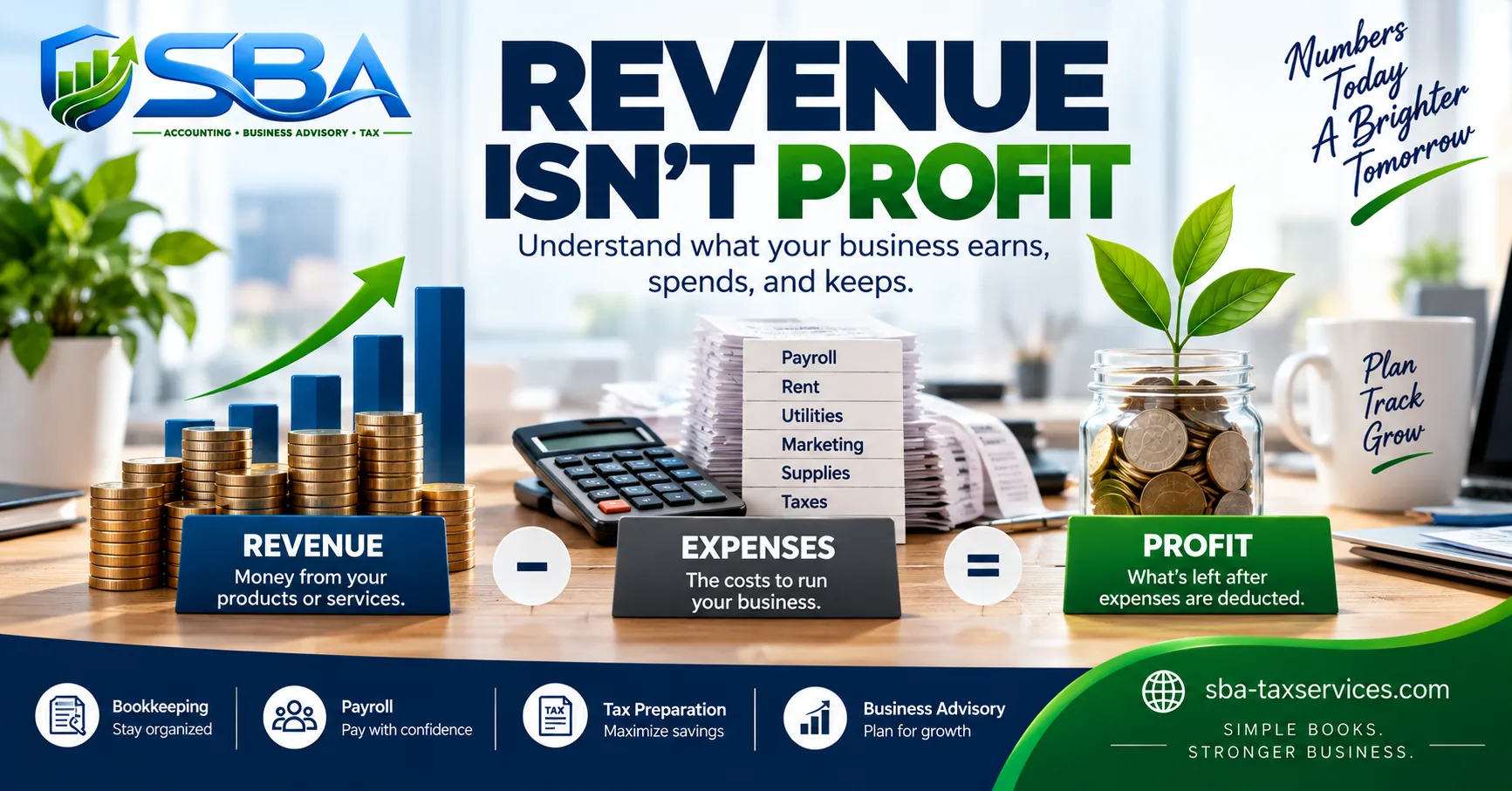
When business owners look at their sales numbers, it can be tempting to assume that more revenue means the business is doing better. But revenue and profit tell two different stories. Understanding the difference between revenue vs. profit helps you evaluate performance, plan spending, and make informed business decisions.
Revenue is the income a business earns from selling products or providing services before the business subtracts expenses. Accountants often call revenue the top line because it appears near the beginning of an income statement.
For example, if a business completes sales totaling $20,000 during a month, its revenue for those sales is $20,000. That figure describes sales activity, but it does not tell the owner how much money the business has earned after paying its costs.
Profit is what remains after the business subtracts relevant costs from revenue. The amount depends on which expenses are included in the calculation. However, a business can generate substantial revenue and still have a small profit—or a loss—if its costs are high.
A simple way to express the relationship is:
Revenue − Expenses = Profit
Two common profit measures are gross profit and net profit. They answer different questions. Therefore, you should not treat these measures as interchangeable.
Gross profit generally equals revenue minus the direct costs associated with producing goods or delivering services (often called cost of goods sold or cost of sales). It helps show how much is left from sales after those direct costs.
Net profit is the amount remaining after the expenses included in the business’s income statement have been deducted, which can include operating expenses and other applicable costs. It gives a broader view of profitability for the period. The precise presentation may vary by business and accounting method.
Imagine a small business reports $20,000 in revenue for a month. It has $8,000 in direct costs and another $9,000 in operating expenses.
As a result, the example shows why the revenue figure alone is incomplete. The business brought in $20,000, but only $3,000 remained after the costs included above. Actual financial statements may include additional expenses, income, adjustments, or tax items.
In addition, profit and cash flow are different. A business generally records revenue and expenses according to its accounting method, while cash flow tracks cash moving into and out of the business. Timing differences—such as customers paying invoices later or the business paying suppliers before collecting—can affect available cash. A profitable business can still experience cash-flow pressure, so owners should review both profitability and cash position.
Accurate bookkeeping and timely financial reporting make it easier to understand what the business earns, spends, and retains. SBA provides bookkeeping services, business tax advisory, payroll services, and ways to contact our team to discuss your business needs.
Revenue tells you how much your business brings in; profit shows what remains after the costs included in the calculation. Tracking both—along with cash flow—gives you a more complete picture of business performance.
This article is for general educational purposes and is not individualized accounting, legal, or tax advice. The treatment of revenue, costs, and profit can depend on your business and accounting method.
Understand revenue vs. profit, how gross and net profit differ, and why small businesses should track expenses, margins, and cash flow.