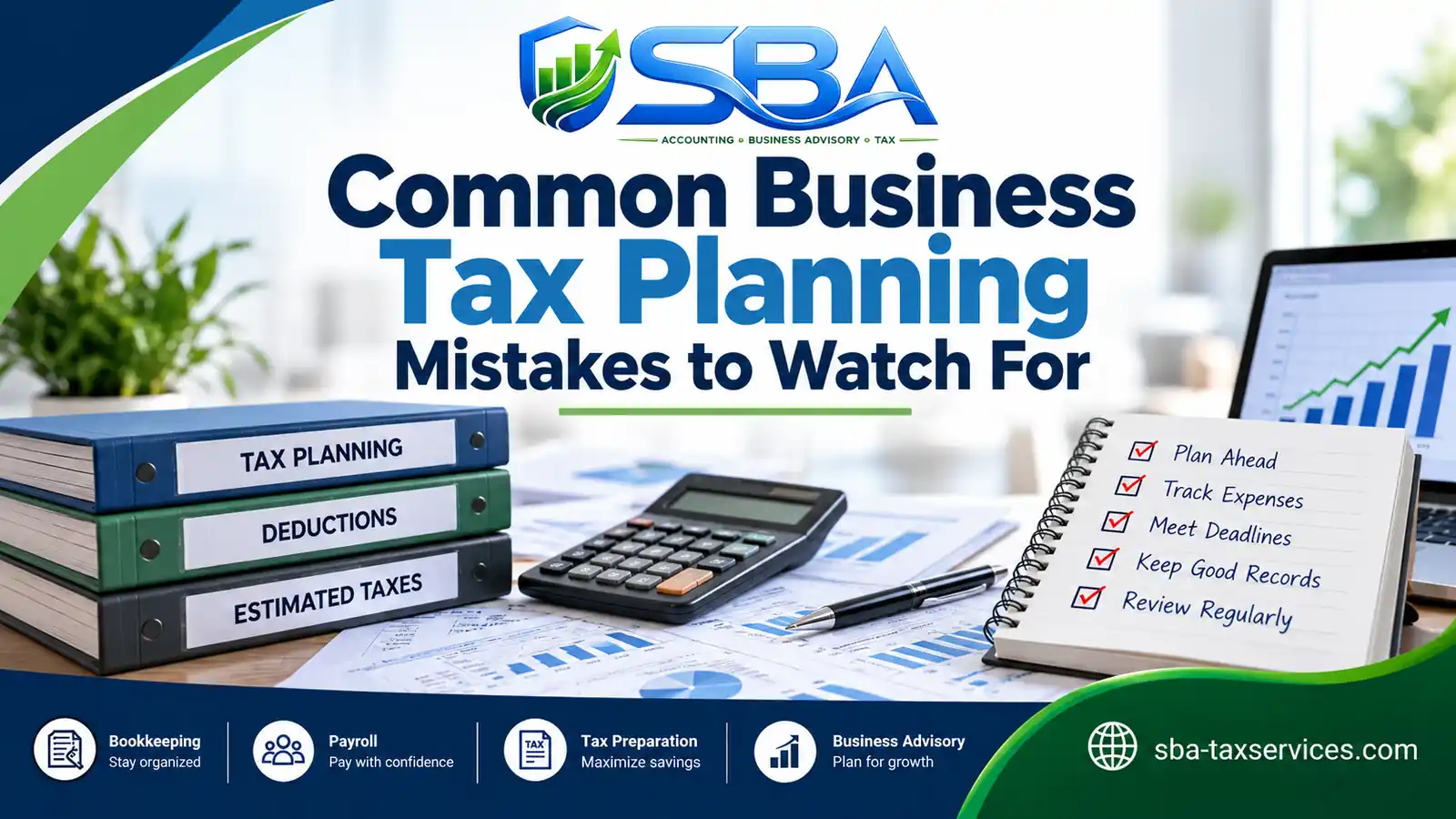
Business tax planning mistakes often begin with ordinary habits: waiting too long to organize documents, assuming last year’s tax situation will repeat, or treating tax preparation as a once-a-year task. However, a consistent review process can help business owners identify issues earlier and prepare more effectively. In this guide, we’ll examine common mistakes and practical ways to build a more reliable tax-planning routine.
04 Expense mistakes 05 Payroll responsibilities 06 Cash-flow reviews
Business Tax Planning Mistake #1: Waiting Until Tax Season
One of the most common business tax planning mistakes is treating planning as something that happens only when a return is due. By then, the business may have already completed most of its spending, hiring, equipment purchases, and other major decisions for the year. As a result, there may be less time to investigate missing records or consider available options.
Instead, tax planning works best as an ongoing process. Regular reviews give owners time to understand current results, gather supporting documents, and ask questions before a decision becomes difficult to change. For example, a monthly review can reveal unusual costs or changing profit levels sooner than a year-end review.
Schedule periodic financial reviews. At a minimum, update bookkeeping, reconcile accounts, and note significant business changes regularly. Then arrange a focused tax-planning review before year-end. For a broader framework, see SBA’s business tax planning guide.
Business Tax Planning Mistakes: Overlooking Estimated Tax Payments
Profitable businesses can still experience tax-related cash-flow pressure when owners fail to plan for payments during the year. In the United States, federal income tax generally operates on a pay-as-you-go basis. Therefore, some business owners must make estimated tax payments rather than waiting until they file an annual return. Requirements depend on the taxpayer’s circumstances and business structure, so check the current IRS rules instead of assuming that last year’s payment pattern still applies.
Moreover, estimating payments from memory—or relying on last year’s amount without reviewing current results—can leave a business underprepared. Income, deductions, credits, and other circumstances may change from one year to the next.
Use current bookkeeping reports to review performance and discuss estimated payments with a qualified tax professional. Revisit estimates when relevant circumstances change, and keep payment confirmations with your tax records. Consult the IRS guide to estimated taxes for official information.
Business Tax Planning Mistakes: Keeping Complete Records
Disorganized invoices, receipts, bank records, payroll documents, and other supporting information make tax planning harder. These records often sit across email, paper folders, and personal devices. In fact, incomplete records are among the business tax planning mistakes that can make a routine review take much longer. Furthermore, missing supporting documents can keep accounting-software totals from telling the full story.
The IRS explains that business records help owners track income, identify expenses, prepare financial statements, and support the items they report on tax returns. Accordingly, recordkeeping should be part of the regular operating routine—not an emergency project before filing.
Organize documents by year and category, including income, purchases, operating expenses, payroll, assets, tax payments, and filed returns. Then reconcile the books against bank and credit-card statements on a consistent schedule. SBA’s guide to small business tax records offers a practical starting point.
Avoid Business Tax Planning Mistakes by Separating Expenses
Small business owners sometimes pay personal costs from a business account or use one card for both personal and business purchases. Although this may seem convenient, it can make bookkeeping less reliable and complicate the process of identifying legitimate business expenses. More importantly, a payment from a business account does not automatically become a deductible business expense.
The IRS explains that personal, living, or family expenses generally are not deductible as business expenses. When a cost has both business and personal use, determine and document the business portion appropriately. Therefore, keep business and personal transactions separate where possible, retain supporting documents, and record any mistakenly paid personal transaction correctly rather than classifying it as an operating expense.
Business Tax Planning Mistakes: Assuming Every Expense Is Deductible
Another common business tax planning mistake occurs when owners assume they can deduct every business purchase immediately. In practice, tax treatment depends on the nature of the expense, how it is used, applicable rules, and the business’s circumstances. For example, equipment or other property may require different treatment from an ordinary operating cost. Likewise, a meal, vehicle expense, travel cost, or mixed-use purchase may require additional documentation or specific treatment.
Consequently, a bank statement alone may not establish that a deduction is allowable. Keep the receipt or invoice and document the business purpose where needed. In addition, ask a tax professional about uncertain, mixed-use, or unusual expenses before relying on a particular tax treatment. The IRS provides details in its guidance on business records to keep.
Business Tax Planning Mistakes: Missing Payroll Tax Responsibilities
Hiring employees creates responsibilities beyond issuing paychecks. Depending on the circumstances, employers may need to withhold federal income tax, handle Social Security and Medicare taxes, make required deposits, and file employment-tax returns and information statements. Therefore, after processing payroll, check that you have also met every related tax obligation.
Even when a payroll provider helps process payments, owners should understand which filings and deposits the provider handles and which responsibilities remain with the employer. Maintain a calendar for payroll filings and deposits, review reports and payment confirmations, and promptly investigate missing confirmations or notices. The IRS outlines these duties in its guidance on understanding employment taxes.
Tax Planning Mistake #7: Relying on Last Year’s Tax Situation
Previous returns can provide a useful starting point. Nevertheless, they are not a guarantee that this year’s result or obligations will be the same. A business may hire employees, change operations, purchase significant equipment, experience a change in profit, or operate under different circumstances. In addition, federal and state tax rules may change.
Use last year’s return as a reference, then compare it with current-year records and business developments. Review significant changes with a qualified tax professional, and verify current rules using authoritative sources instead of relying solely on old notes or online summaries.
Business Tax Planning Mistakes and Cash-Flow Decisions
A business can show a profit on its reports and still have limited cash available on a particular payment date. For that reason, ignoring the connection between tax obligations and cash flow is another of the business tax planning mistakes worth reviewing early. This can happen when customers pay late, inventory needs increase, debt payments fall due, or the business makes a large purchase. Therefore, tax planning should be connected to cash-flow planning.
Setting aside money for anticipated tax obligations can help owners avoid treating all available cash as money they can safely spend. However, the amount and timing should be based on the business’s circumstances and relevant tax requirements—not on an arbitrary percentage alone. Review cash flow alongside profit-and-loss reports, identify expected tax dates and major expenses, and discuss an appropriate reserve and payment plan with your tax professional.
Prevent Business Tax Planning Mistakes with Regular Reviews
Even a good system can become outdated if no one checks it. For example, a bookkeeping process that worked when the business had only a few transactions each month may no longer be sufficient after adding employees, services, locations, or sales channels. Similarly, waiting until a deadline is close can reduce the time available to resolve missing records or understand an unfamiliar tax issue.
Establish a recurring tax-readiness review. Check bookkeeping status, upcoming payments, payroll responsibilities, major purchases, business changes, and unresolved questions. If a matter involves uncertain tax treatment or a significant financial decision, seek advice before acting whenever practical.
- Bookkeeping is current and accounts have been reconciled.
- Income, expense, payroll, and asset records are organized.
- Personal and business transactions are classified correctly.
- Unusual or uncertain expenses have been flagged for review.
- Estimated tax requirements and payment records have been checked.
- Payroll deposits and filing responsibilities are understood.
- Significant business changes have been documented.
- Upcoming tax dates and expected cash needs are on the calendar.
- Questions for the tax professional have been collected.
You do not need to resolve every tax question during one meeting. Instead, identify what is complete, what needs clarification, and who will handle each next step. Then revisit open items during the next review.
Frequently Asked Questions
What are the most common business tax planning mistakes?
Common mistakes include waiting until filing season to plan, overlooking estimated tax payments, keeping incomplete records, mixing personal and business expenses, assuming every purchase is deductible, and missing payroll or filing responsibilities. The right priorities depend on the business’s structure and circumstances.
How often should a small business review its tax plan?
A monthly financial review is a practical starting point for many small businesses, with additional reviews when significant changes occur. However, the appropriate schedule depends on transaction volume, payroll, tax obligations, and business complexity.
Does a profitable business always have enough cash to pay its taxes?
No. Profit and cash available on a particular date are not the same thing. For that reason, owners should review cash flow, expected expenses, and anticipated tax payments together.
Can a business deduct personal expenses paid from its business account?
Generally, personal, living, or family expenses are not deductible as business expenses merely because a business account paid for them. Mixed-use costs may require an appropriate allocation. Review uncertain transactions with a qualified tax professional.
Should I use last year’s tax return to plan this year’s taxes?
It can be a useful reference, but it should not be the only input. Current income, expenses, business changes, estimated payments, and current rules also matter. Therefore, compare the prior return with up-to-date records before making decisions.
How SBA Accounting and Tax Services PLLC Can Help
Accurate records and a repeatable review process make tax planning more manageable. SBA Accounting and Tax Services PLLC offers services including bookkeeping, payroll, tax preparation, and business tax advisory support to help small businesses organize financial information and evaluate tax-related questions.
If your records are behind, your business has changed, or you are unsure which tax questions to address first, consider arranging a conversation about your current needs. The right next step depends on your business structure, records, and circumstances.
For support with filing and preparing returns, explore our Tax Preparation services. For year-round planning and business decisions, learn more about our Business Tax Advisory Services. You can also review our Bookkeeping Services to learn how consistent records support tax readiness.
Final Thoughts
Avoiding business tax planning mistakes does not require a complicated system. Instead, it starts with consistent bookkeeping, organized supporting records, timely reviews, and a clear understanding of upcoming responsibilities.
Most importantly, do not wait for filing season to investigate every question. Review the numbers throughout the year, document important decisions, and seek qualified guidance when the tax treatment is uncertain. By making tax readiness part of regular business management, you can approach tax preparation with better-organized information and fewer last-minute surprises.
Need help organizing your records or reviewing your business tax-planning process? Contact SBA Accounting and Tax Services PLLC to discuss bookkeeping, payroll, tax preparation, and business tax advisory services.
Educational disclaimer: This article provides general information for small business owners and is not individualized tax, legal, or accounting advice. Requirements vary by business structure, tax year, jurisdiction, and facts. Verify current requirements with the IRS, applicable state and local agencies, or a qualified professional.