Year-end tax planning gives small business owners an opportunity to review their financial position, identify potential tax-saving opportunities, and prepare for the upcoming tax filing season.
Year-end tax planning helps business owners review income, expenses, estimated tax payments, payroll, equipment purchases, retirement contributions, and financial records before December 31. Waiting until tax season to organize these items can leave important decisions until it is too late.
As 2026 comes to a close, recent tax-law changes may also affect which deductions and planning strategies apply. Whether you operate a sole proprietorship, partnership, LLC, S corporation, or C corporation, a structured review can help you make informed decisions and prepare for filing season.
Key takeaway: Start with accurate bookkeeping, review projected income and tax liability, and confirm which actions must be completed before year-end. A deduction should support a sound business decision—not drive an unnecessary purchase.
1. Year-End Tax Planning: Review Business Income and Profit
Start your year-end tax planning process by understanding how your business performed during 2026. Your bookkeeping should provide a clear picture of revenue, expenses, gross profit, net income, and outstanding balances. However, your bank balance alone does not show how much profit your business earned or how much tax you may owe.
As part of your year-end tax planning, review your profit and loss statement, balance sheet, cash flow statement, accounts receivable aging report, accounts payable report, and year-to-date payroll summary. Then compare actual results with your budget and the previous year.
For example, if revenue increased while operating expenses remained relatively stable, your business may have higher taxable income than expected. Conversely, lower sales or higher operating costs may affect your projected tax liability. Also investigate unusual transactions, owner distributions, and significant changes in revenue.
Practical tip: Ask your bookkeeper or accountant to prepare an updated profit and loss statement through October or November. Use the latest reliable information to estimate your full-year results.
2. Year-End Tax Planning for Business Expenses
Business expenses deserve careful attention before the year ends. This expense review is an important part of small business year-end tax planning. Although many ordinary and necessary business expenses may be deductible, the tax treatment depends on the expense, business purpose, accounting method, and applicable tax rules.
Review rent and utilities, business insurance, advertising, professional fees, software subscriptions, office supplies, repairs, travel, employee wages, benefits, interest, and bank charges. Look for transactions that may have been incorrectly categorized or recorded.
For example, a computer purchased for long-term business use may need to be treated as depreciable property rather than an ordinary office supply expense. Likewise, personal expenses should not be mixed with business deductions. Keep documentation that establishes the business purpose of each expense.
If your business uses the cash method, payment timing may affect when certain expenses are recognized. However, paying an expense early does not automatically make the entire amount deductible in the current year. Prepayment rules and other limitations may apply.
Review your monthly bookkeeping checklist before making year-end adjustments.
3. Year-End Tax Planning for Equipment and Depreciation
Equipment purchases can have a significant effect on business taxes. Therefore, include planned purchases in your year-end tax planning review before December 31. Depending on the property and applicable requirements, a business may recover the cost of qualifying equipment through regular depreciation, Section 179 expensing, or additional first-year depreciation.
For tax years beginning in 2026, the IRS states that the maximum Section 179 expense deduction is $2,560,000. The limit is reduced by the amount that the cost of Section 179 property placed in service during the year exceeds $4,090,000. The maximum Section 179 amount for qualifying sport utility vehicles is $32,000.
These limits are subject to eligibility rules and other restrictions. In particular, the deduction may be limited by taxable business income and the type of property placed in service.
Understand 100% Bonus Depreciation
Legislation enacted in 2025 restored permanent 100% additional first-year depreciation for certain qualifying property acquired after January 19, 2025. Eligibility depends on acquisition dates, property classification, placed-in-service requirements, business use, and other statutory conditions. Certain elections may also affect the amount claimed.
Importantly, purchasing an asset alone is not enough. The property generally must be placed in service during the applicable tax year to qualify for the corresponding deduction. Before purchasing equipment solely to reduce taxes, evaluate whether the investment makes financial sense. A deduction reduces taxable income; it does not reimburse the entire purchase price.
Review the IRS guidance in Publication 946: How to Depreciate Property and discuss the appropriate treatment with your tax professional.
4. Year-End Tax Planning and Estimated Tax Payments
Estimated tax payments should be part of every small business tax-planning review. Owners who do not have sufficient tax withholding may need to make payments during the year. This is particularly important for sole proprietors, self-employed individuals, partners, and S corporation shareholders who receive pass-through income.
For 2026, individuals generally need to consider estimated payments if they expect to owe at least $1,000 after withholding and refundable credits and expect withholding and credits to be less than the smaller of 90% of the tax shown on the 2026 return or 100% of the tax shown on the 2025 return, subject to special rules. Higher-income taxpayers and certain other taxpayers may have different requirements.
Review expected income, withholding, self-employment tax exposure, payments already made, and applicable state and local obligations. The fourth federal estimated tax installment for calendar-year individuals is generally due January 15, 2027. Special rules and exceptions can apply, including a rule for taxpayers who file and pay by January 31.
Use IRS Publication 505: Tax Withholding and Estimated Tax to review the requirements. Do not wait until the filing deadline to discover an estimated tax shortfall.
5. Year-End Tax Planning for Payroll and Compensation
Payroll deserves a separate year-end tax-planning review because errors can affect employees, business deductions, payroll tax filings, and information returns. Review employee wages, withholding, Social Security and Medicare taxes, employer liabilities, benefits, reimbursements, bonuses, contractor payments, payroll deposits, and filing records.
If you operate an S corporation, review shareholder-employee compensation as well. The IRS generally requires an S corporation to pay reasonable compensation to a shareholder-employee for services performed before making non-wage distributions. The appropriate amount depends on the facts and circumstances, including duties, experience, time devoted to the business, and comparable compensation.
Do not treat distributions as a substitute for reasonable wages. In addition, review bonus timing and payroll processing with your payroll provider. The tax treatment of compensation can depend on the business’s accounting method and other applicable rules.
A reliable small business payroll process can help organize compensation records and prepare for year-end reporting.
6. Year-End Tax Planning for Retirement Contributions
Retirement plans may provide tax-planning opportunities for business owners and eligible employees. Include these options in your year-end tax planning discussion. Depending on the plan type, contribution limits, employee eligibility, and applicable deadlines, contributions may reduce taxable income or provide other tax benefits.
Review whether a SEP IRA, SIMPLE IRA, individual 401(k) or Solo 401(k), traditional 401(k), or another qualified employer-sponsored plan fits your business. Contribution deadlines differ by plan type and taxpayer circumstances. Some plans require establishment or employee deferrals before year-end, while certain employer contributions may be permitted later.
Therefore, do not assume that every retirement contribution can be made after December 31. Contact your plan administrator and tax professional early enough to confirm plan documents, employee eligibility, contribution limits, and funding deadlines.
7. Examine Inventory and Outstanding Receivables
Businesses that maintain inventory should review quantities, valuation, and obsolete products before closing the year. Compare physical inventory with accounting records and investigate damaged goods, missing inventory, obsolete products, and differences between recorded and actual quantities.
However, do not automatically write off inventory simply because it is slow-moving. Applicable inventory valuation and deduction rules must support the adjustment.
Next, review accounts receivable. Identify overdue invoices, disputed balances, potentially uncollectible accounts, customer payment arrangements, and credit memos. For accrual-method businesses, bad-debt treatment depends on specific tax rules. A business generally cannot deduct an ordinary estimated reserve for future bad debts; the deduction rules typically require a qualifying debt to become worthless. Document collection efforts and review each balance carefully.
8. Year-End Tax Planning: Business Structure and Tax Elections
Your business structure affects how income is reported, how taxes are calculated, and which deductions or elections may be available. Before year-end, consider whether your current structure continues to fit your business.
Review sole proprietorship reporting, partnership allocations and distributions, S corporation compensation and distributions, C corporation taxable income and retained earnings, LLC tax classification, ownership changes, new business activities, and state filing obligations.
For example, an LLC may be taxed as a disregarded entity, partnership, or corporation depending on its ownership and elections. Likewise, an S corporation election can create different payroll and tax responsibilities.
Do not change your entity structure solely because another business owner claims it saves taxes. Consider legal, administrative, payroll, and tax consequences before making a change. If you are evaluating your current structure, business tax advisory services can help you assess the available options.
9. Year-End Tax Planning: Organize Tax Records and Bookkeeping
Accurate records are essential for preparing a complete business tax return and form the foundation of effective year-end tax planning. Use November and December to organize supporting documents rather than waiting until filing season.
- Bank and credit card statements.
- Reconciled accounting records and financial statements.
- Sales reports, expense receipts, and invoices.
- Payroll reports and contractor payment records.
- Loan statements and equipment purchase documents.
- Vehicle mileage and business-use records.
- Inventory reports and prior-year tax returns.
- Estimated tax payment confirmations.
Also reconcile bank accounts, credit cards, loans, and other balance sheet accounts. Investigate unexplained differences before closing the books. In addition, verify that personal transactions have not been incorrectly recorded as business expenses.
A clean set of books can make tax preparation more efficient and help identify issues before they become filing problems.
10. Prepare a Year-End Tax Planning Calendar for 2027
Your year-end tax planning should not end when the calendar changes. Instead, use the final weeks of 2026 to establish a financial and tax-planning calendar for 2027.
Include reminders for monthly bookkeeping reviews, quarterly estimated tax payments, payroll tax deposits and filings, sales tax returns, annual information returns, business license renewals, retirement plan deadlines, financial statement reviews, and tax planning meetings.
Specific deadlines depend on your business structure, location, payroll responsibilities, and filing requirements. Furthermore, consider scheduling periodic reviews with your accountant rather than waiting until tax season. Regular reviews can help identify changes in profitability, cash flow, payroll, and tax exposure while there is still time to respond.
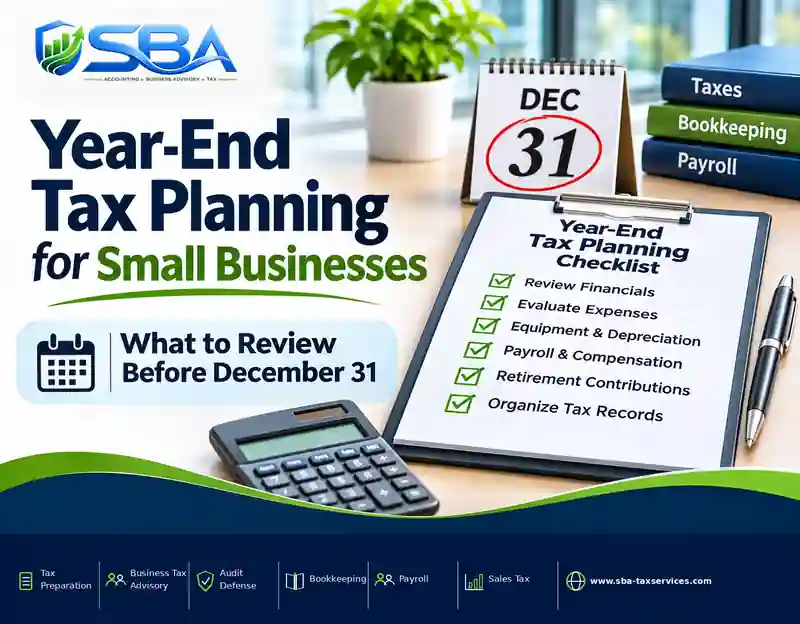
Your Small Business Year-End Tax Planning Checklist
Use this checklist to organize your final review before December 31:
- Reconcile business bank and credit card accounts.
- Review year-to-date revenue and expenses.
- Prepare an updated profit and loss statement.
- Review projected taxable income and estimated tax payments.
- Evaluate equipment purchases and depreciation eligibility.
- Review payroll, bonuses, and employee compensation.
- Confirm retirement plan deadlines and contributions.
- Review inventory and outstanding receivables.
- Organize receipts, invoices, and supporting records.
- Review business structure and tax elections.
- Schedule your 2027 tax and bookkeeping calendar.
- Discuss significant tax decisions with your tax professional.
Completing these steps does not guarantee a lower tax bill. Nevertheless, it can help your business enter filing season with more accurate records and fewer surprises.
Year-End Tax Planning: Frequently Asked Questions
When should a small business start year-end tax planning?
Ideally, businesses should review their finances throughout the year. However, November and December are particularly useful for reviewing projected income, expenses, estimated payments, payroll, and potential year-end decisions.
What should a small business review before December 31?
Review revenue, operating expenses, equipment purchases, depreciation, estimated taxes, payroll, retirement plans, inventory, accounts receivable, and financial records. Also confirm which decisions must be completed before the tax year ends.
Can I reduce my business taxes by purchasing equipment before year-end?
Potentially. Qualifying equipment may be eligible for depreciation, Section 179 expensing, or additional first-year depreciation. Eligibility depends on the property, acquisition date, placed-in-service date, business use, and applicable limitations.
Should I pay business expenses early to reduce taxes?
Not automatically. The timing of deductions depends on your accounting method and applicable tax rules. Certain prepaid expenses must be allocated to the periods they cover, and personal expenses are not deductible merely because the business paid them.
Do small business owners need to make estimated tax payments?
Some do. Individuals who expect to owe at least $1,000 after withholding and refundable credits may generally need estimated payments, subject to applicable exceptions and safe-harbor rules.
Can an S corporation owner take distributions instead of salary?
Generally, no. An S corporation shareholder-employee who performs services must receive reasonable compensation for those services before non-wage distributions are treated as distributions rather than wages.
Can I make retirement contributions after December 31?
Some employer retirement contributions may be made after year-end, depending on the plan and applicable deadlines. However, certain plans and employee deferrals have earlier requirements. Confirm the rules with your plan administrator.
Why should I review my bookkeeping before tax season?
Accurate bookkeeping helps identify missing transactions, incorrect expense classifications, unreconciled accounts, and incomplete supporting documents. Consequently, it can make tax preparation more efficient and reduce avoidable errors.
Make Year-End Tax Planning Part of Your Business Strategy
Year-end tax planning is an important part of managing a financially healthy business. By reviewing income, expenses, payroll, estimated taxes, equipment purchases, and records before December 31, you can make more informed decisions and prepare for the upcoming filing season.
More importantly, consistent bookkeeping and periodic tax reviews can help identify opportunities throughout the year rather than waiting until the last minute. Every business has different tax circumstances. Therefore, evaluate potential strategies with a qualified tax professional before making significant financial or tax decisions.
Need Help Preparing Your Business for Year-End?
A year-end financial review can help identify bookkeeping gaps, evaluate potential tax-planning opportunities, and prepare your business for the upcoming filing season.
SBA Accounting and Tax Services PLLC provides bookkeeping, payroll, business tax preparation, and year-round tax advisory services to help small businesses stay organized and make informed financial decisions.
Explore Our Services
Bookkeeping | Payroll | Business Tax Preparation | Business Tax Advisory | Individual Tax Preparation | Individual Tax Planning
Tax information in this article is for general educational purposes. Tax treatment depends on individual circumstances, applicable federal and state laws, and current IRS guidance. Consult a qualified tax professional regarding your situation.