
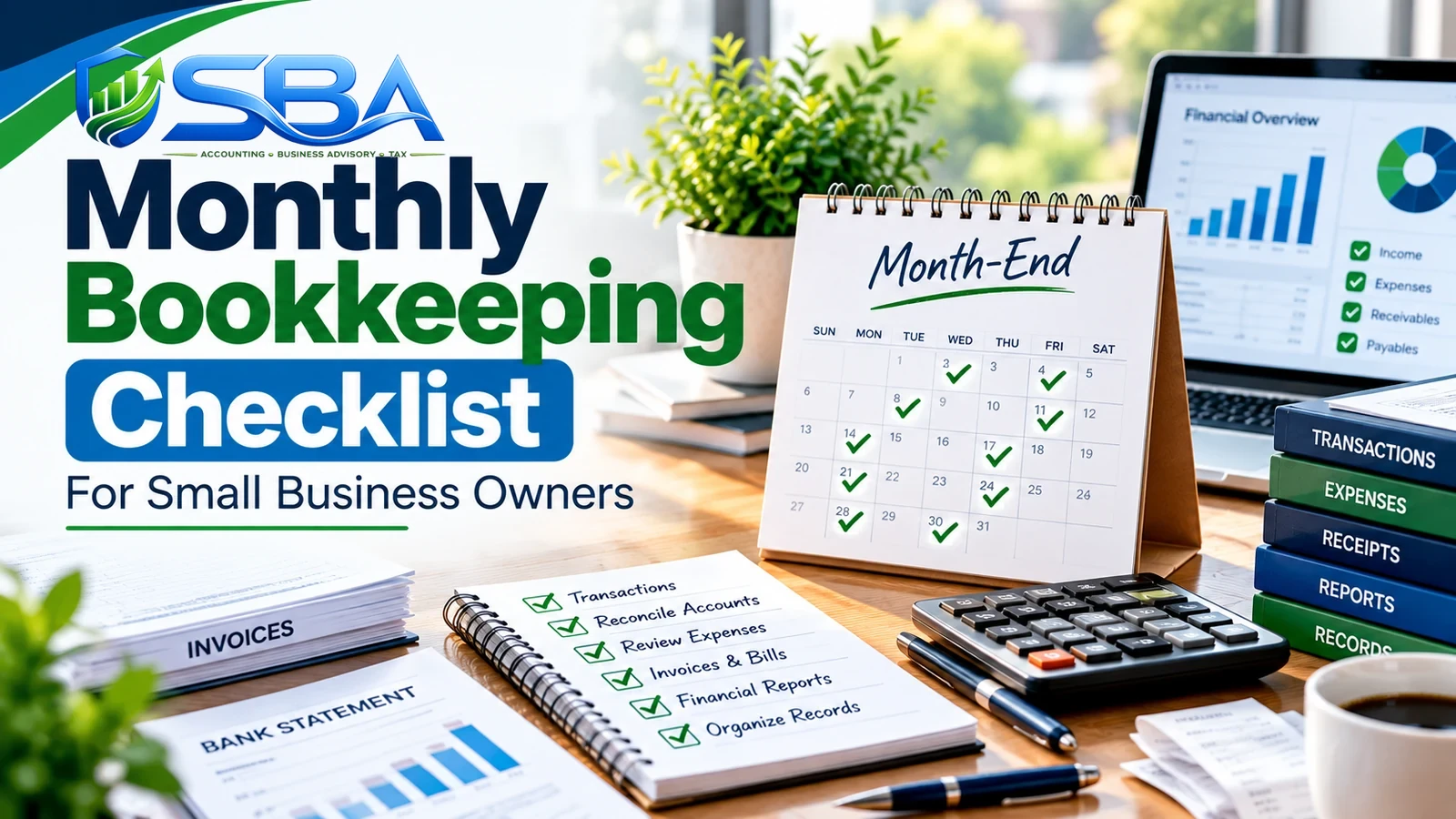
A monthly bookkeeping checklist gives small business owners a repeatable way to review sales, expenses, payments, payroll, bank activity, and other financial details each month.
However, bookkeeping can become difficult when these tasks are left until the end of the quarter or tax season.
A monthly bookkeeping checklist gives you a repeatable way to review your financial records before small issues become harder to trace. Instead of trying to remember everything each month, you can work through the same core tasks in a consistent order.
Ultimately, the goal is not to make bookkeeping complicated. It is to create a routine that helps you keep your records organized, identify differences, and understand what happened financially during the month.
Why a Monthly Bookkeeping Checklist Matters
First, good bookkeeping starts with consistent records.
The IRS explains that businesses should maintain records that clearly show income and expenses. Supporting documents such as invoices, receipts, deposit records, account statements, and canceled checks can provide information needed to support entries in the books.
In addition, a monthly review can also help you:
- identify missing transactions
- catch unusual expenses
- reconcile bank accounts
- review unpaid customer balances
- monitor business expenses
- organize supporting documents
- review financial reports
- prepare for upcoming obligations
In addition, reviewing your records regularly can make it easier to spot changes in your business before they become difficult to explain.
Monthly Bookkeeping Checklist: 10 Tasks to Complete
Use the following monthly bookkeeping checklist as a practical starting point. The exact tasks your business needs will depend on its activities, accounting method, financial accounts, payroll, inventory, and other circumstances.
1. Record All Business Transactions
First, start by making sure the month’s transactions have been recorded.
Review your:
- sales
- customer payments
- vendor payments
- business expenses
- bank transactions
- credit-card activity
- loan payments
- owner contributions or withdrawals
- other applicable business transactions
The IRS explains that business transactions generate supporting documents and that these documents provide information used to record transactions in the books. See the IRS guidance on recording business transactions.
Therefore, do not rely only on memory when completing your monthly review. If a transaction is missing, determine what documentation is available and record it appropriately.
2. Reconcile Your Business Bank Accounts
Next, compare your bookkeeping records with your bank activity.
A bank reconciliation can help identify differences between what your books show and what the bank reports.
For example, review:
- deposits
- checks
- electronic payments
- transfers
- bank fees
- outstanding transactions
- other account activity
Investigate differences rather than simply forcing the balances to agree.
IRS Publication 583 discusses checking-account reconciliation as part of a business recordkeeping system and states that a checking account should be reconciled each month.
For a detailed explanation, see our guide on How to Reconcile Your Business Bank Account.
3. Review Credit-Card and Other Financial Accounts
However, bank reconciliation is only one part of a monthly bookkeeping checklist. Review the other financial accounts used by the business as well.
If your business uses credit cards, payment platforms, merchant accounts, or other financial accounts, review those accounts as well.
In particular, check that:
- transactions have been recorded
- payments have been classified correctly
- balances are reasonable
- unusual transactions have been investigated
- supporting documents are available where appropriate
This step can be especially useful when a business has multiple accounts.
4. Review Business Expenses
Next, review the expenses recorded during the month.
For example, look for:
- missing expenses
- duplicate entries
- unusual charges
- recurring subscriptions
- incorrectly categorized transactions
- personal transactions that may have entered business records
- expenses requiring additional documentation
The IRS explains that supporting records should provide information about business expenses and that supporting documents help substantiate entries in the books and tax return.
For a deeper review of expense tracking, see Business Expenses: What to Track and Why Accurate Records Matter.
Remember that recording an expense does not automatically mean the expense is deductible. Tax treatment can depend on the type of expense and other facts.
5. Review Accounts Receivable
Next, if customers purchase from your business on credit, review your outstanding receivables.
To begin, ask:
- Which invoices remain unpaid?
- Which invoices are approaching their due dates?
- Which invoices are overdue?
- Are there customer balances that need follow-up?
- Are payments being applied to the correct invoices?
In addition, this review is an important part of a monthly bookkeeping checklist because it can help you understand how much money customers still owe the business.
More importantly, it connects bookkeeping with cash-flow planning. A sale recorded as revenue does not necessarily mean the cash has already been collected.
For additional guidance, see Cash Flow for Small Businesses: A Practical Beginner’s Guide.
6. Review Accounts Payable and Upcoming Bills
Then, review what the business owes.
Look at:
- unpaid vendor invoices
- upcoming bills
- recurring payments
- loan payments
- taxes
- payroll-related obligations
- other scheduled payments
The purpose is not simply to record bills. It is also to understand what financial obligations are coming next.
As a result, this step can help connect bookkeeping with short-term financial planning.
7. Check Payroll and Related Records
Likewise, if your business has employees, include payroll in the monthly review.
Depending on your business and payroll system, review applicable:
- payroll transactions
- wage records
- payroll tax records
- payroll-related liabilities
- payroll payments
- benefit-related transactions
The IRS states that employment tax records generally must be kept for at least four years. Keep the applicable records organized and follow the requirements that apply to your business.
8. Review Your Financial Reports
After the underlying transactions have been reviewed, use your monthly bookkeeping checklist to make time for a review of the financial reports.
At a minimum, many business owners should understand what their financial reports show:
- income statement or profit and loss statement
- balance sheet
- cash-flow information
are showing.
In other words, each report answers a different question.
The income statement focuses on revenue, expenses, and profitability.
The balance sheet provides a snapshot of assets, liabilities, and equity.
Cash-flow information helps you understand the movement of cash.
For a detailed explanation, read Financial Reports Every Small Business Owner Should Understand.
9. Investigate Unusual Changes
However, do not stop at reviewing the reports.
Ask what changed.
For example, consider these questions:
- Did an expense increase significantly?
- Did revenue change unexpectedly?
- Did accounts receivable increase?
- Did cash decline?
- Did a recurring expense change?
- Did a new liability appear?
- Did a transaction get categorized differently from previous months?
Instead, the objective is not to assume that every change is a problem.
Instead, use the monthly bookkeeping review to identify changes that deserve explanation.
For example, sometimes an increase is perfectly reasonable because the business purchased equipment, hired employees, launched a marketing campaign, or experienced seasonal activity.
Ultimately, the important point is to understand the reason for the change.
10. Organize Supporting Documents
Finally, organize the documents supporting the month’s transactions.
Depending on the business, these may include:
- invoices
- receipts
- bank statements
- deposit records
- credit-card statements
- canceled checks
- payroll records
- purchase documents
- other supporting records
The IRS recommends keeping supporting documents in an orderly and safe manner. A consistent filing system can make future reviews easier and can help you locate information when preparing tax returns or working with an accounting professional.
A Simple 30-Minute Monthly Bookkeeping Checklist Review
Not every business needs the same amount of bookkeeping time. However, a simple monthly review can follow this sequence:
First 5 minutes: Check transaction completeness
Review bank, credit-card, payment-platform, and other relevant activity.
Next 10 minutes: Reconcile and investigate
Compare account activity with your bookkeeping records and investigate differences.
Next 5 minutes: Review outstanding items
Check unpaid customer invoices, unpaid bills, and upcoming financial obligations.
Next 5 minutes: Review financial reports
Look at revenue, expenses, cash position, and other important financial information.
Final 5 minutes: Document follow-up items
Write down anything that needs additional attention.
This process is a practical framework, not a universal requirement. Businesses with greater transaction volume or complexity may need a more detailed monthly close process.
Monthly Bookkeeping Checklist
For convenience, use this condensed version at the end of each month:
Transactions
- ☐ Record business income
- ☐ Record business expenses
- ☐ Review bank activity
- ☐ Review credit-card activity
- ☐ Check other financial accounts
Reconciliation
- ☐ Reconcile bank accounts
- ☐ Reconcile applicable credit-card accounts
- ☐ Investigate differences
- ☐ Review outstanding transactions
Receivables and Payables
- ☐ Review unpaid customer invoices
- ☐ Review overdue receivables
- ☐ Review unpaid vendor bills
- ☐ Check upcoming payments
Payroll and Taxes
- ☐ Review payroll transactions
- ☐ Review applicable payroll liabilities
- ☐ Organize payroll records
- ☐ Review applicable tax obligations
Financial Review
- ☐ Review profit and loss
- ☐ Review balance sheet
- ☐ Review cash-flow information
- ☐ Investigate unusual changes
Records
- ☐ Organize receipts
- ☐ Organize invoices
- ☐ Organize statements
- ☐ Store supporting documentation securely
- ☐ Note unresolved questions for follow-up
Monthly Bookkeeping: What Should You Do If Something Does Not Match?
Importantly, a difference does not automatically mean your bookkeeping is wrong.
For example, it may be caused by:
- an outstanding transaction
- a bank fee
- a transaction recorded in a different period
- a missing entry
- a duplicate entry
- an incorrectly categorized transaction
- an error in the records
First, identify exactly where the difference occurs.
Then, compare the supporting documentation with the accounting records.
Instead, avoid simply changing the books to make the balance agree without understanding why the difference exists.
A good reconciliation process should explain the difference.
How Often Should You Complete a Monthly Bookkeeping Review?
For many small businesses, monthly bookkeeping provides a practical rhythm for reviewing financial activity.
However, the appropriate frequency depends on the business.
A business with a high volume of transactions, frequent payroll, multiple accounts, inventory, or significant cash activity may need more frequent reviews.
Above all, the key is consistency.
As a result, waiting until tax season to discover months of unreconciled transactions can make the review much more difficult.
Therefore, a regular monthly process makes it easier to identify questions while the transactions and supporting documents are still relatively recent.
When Should You Consider Help With Monthly Bookkeeping?
Initially, a business owner may be able to handle basic bookkeeping tasks, particularly when transaction volume is low.
However, additional support may become useful when any of the following applies:
- transactions are increasing
- multiple bank accounts are involved
- payroll has become more complex
- accounts receivable are growing
- financial reports are difficult to interpret
- reconciliations remain unresolved
- bookkeeping is taking time away from running the business
- tax preparation becomes difficult because records are incomplete
The U.S. Small Business Administration identifies bookkeeping, accounts receivable, accounts payable, available cash, bank reconciliation, and payroll among financial functions businesses may need to manage.
If you need ongoing help maintaining organized financial records, SBA Bookkeeping Services provides bookkeeping support for small businesses.
FAQs About Monthly Bookkeeping
What is a monthly bookkeeping checklist?
A monthly bookkeeping checklist is a repeatable list of financial tasks used to review transactions, reconcile accounts, organize records, review outstanding items, and examine financial reports.
What should I reconcile each month?
At a minimum, review the financial accounts used by your business and reconcile applicable bank and credit-card accounts. Businesses with other financial accounts may need additional reconciliation procedures.
Why should small businesses reconcile accounts monthly?
Regular reconciliation can help identify missing transactions, outstanding items, bank charges, duplicate entries, and other differences while the information is still relatively easy to investigate.
Should I review my financial reports every month?
A regular review can help you understand changes in revenue, expenses, cash, assets, liabilities, and other financial information. The appropriate frequency depends on the business.
What records should a small business keep?
In general, the records needed depend on the business and the transactions involved. The IRS explains that supporting documents can include invoices, receipts, deposit slips, account statements, canceled checks, and other documentation supporting business transactions.
Can bookkeeping help with tax preparation?
Yes. In addition, organized business records can provide information needed to prepare tax returns and support items reported on those returns.
Final Thoughts: Make Bookkeeping a Monthly Habit
Fortunately, bookkeeping does not have to become a year-end scramble.
A consistent monthly bookkeeping checklist can help you establish a repeatable process for recording transactions, reconciling accounts, reviewing expenses, checking receivables and payables, reviewing financial reports, and organizing supporting documents.
More importantly, the monthly review gives you an opportunity to understand what changed in your business and why.
Ultimately, the goal is not simply to keep the books updated.
It is to maintain financial information that you can actually use.
If you keep your records organized throughout the year, tax preparation, financial reporting, cash-flow planning, and conversations with your accounting professional can become much easier.
Need help keeping your business books organized? SBA Accounting and Tax Services PLLC provides bookkeeping, accounting, payroll, tax, and business advisory services for small businesses.






One Response