
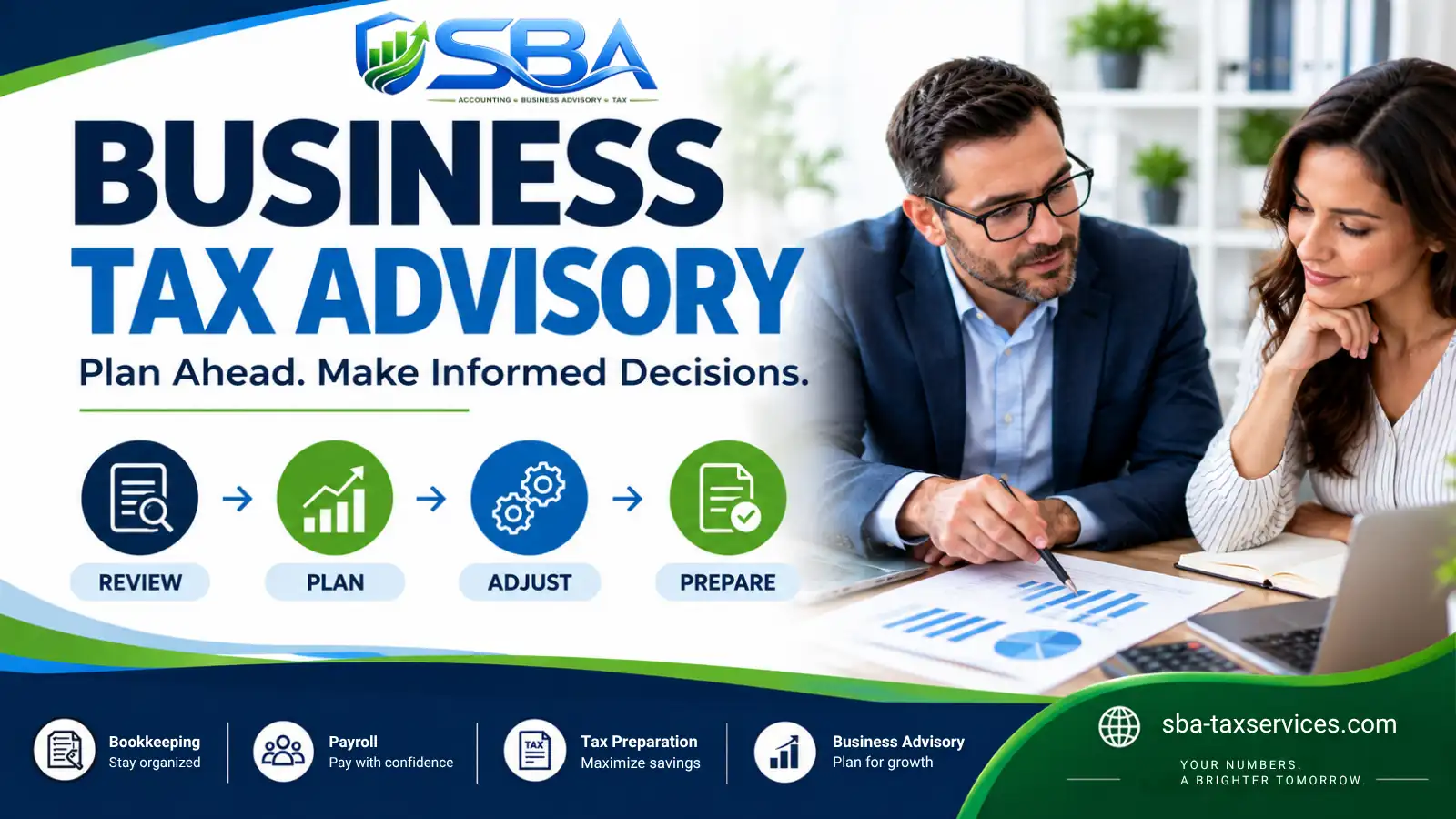
Business tax advisory is broader than simply preparing a tax return. Instead, it focuses on helping business owners think about tax considerations before and during financial or operational decisions.
For example, a business owner may have questions about estimated taxes, a major purchase, changes in income, business growth, recordkeeping, or the tax implications of a planned change. Therefore, tax advisory can provide a more forward-looking perspective while tax preparation remains focused primarily on accurately preparing and filing required returns.
In practice, the right level of support depends on the business, its structure, its financial activity, and the questions the owner needs to answer. Consequently, some businesses may need primarily tax preparation, while others may benefit from ongoing advisory support in addition to preparation.
What Is Business Tax Advisory?
Business tax advisory generally refers to professional guidance that helps a business owner consider tax-related issues while making financial and business decisions.
Unlike tax preparation, which generally centers on preparing and filing a return, advisory work can take place throughout the year. As a result, the discussion may involve current business activity, expected income, estimated taxes, records, business changes, or other circumstances that could affect tax planning.
However, business tax advisory is not a single standardized service with the same scope for every business. The appropriate work depends on the taxpayer’s situation, entity structure, activities, and specific questions.
The IRS explains that the form of business operated affects the taxes a business must pay and how those taxes are paid. See IRS guidance on filing and paying business taxes.
Business Tax Advisory vs. Tax Preparation
The easiest way to understand the difference is to consider when the tax question is being addressed.
| Tax Preparation | Business Tax Advisory |
|---|---|
| Focuses on preparing and filing applicable tax returns. | Focuses on tax-related planning and decisions. |
| Organizes information needed for a filing. | Considers questions that arise during the year. |
| Reviews income, deductions, and supporting information. | Evaluates tax considerations around business changes. |
| Primarily connected with a filing cycle. | Can extend throughout the year. |
That distinction matters because a business can have accurate tax returns and still face tax questions during the year.
For instance, a business owner may expect income to change substantially, consider purchasing equipment, change the way the business operates, add employees, or face another significant financial development. In those situations, waiting until tax-return preparation may leave less time to evaluate the issue.
At the same time, advisory support does not eliminate the need for proper records or accurate filing. The IRS notes that good records help businesses monitor progress, prepare financial statements, identify income, track deductible expenses, prepare tax returns, and support items reported on returns. See IRS recordkeeping guidance.
When Might You Need Business Tax Advisory?
There is no single revenue level or business size at which every owner suddenly needs tax advisory. Instead, the need often becomes more apparent when the business develops more complicated financial activity or when the owner begins facing decisions with potential tax consequences.
1. Your Business Income Is Changing
If income is increasing or decreasing significantly, your tax situation may also require closer attention.
For example, self-employed individuals, partners, and S corporation shareholders generally may need estimated tax payments when they expect to owe at least $1,000 when filing, subject to applicable rules and exceptions. Corporations generally have a different $500 threshold. See current IRS estimated-tax guidance.
Therefore, a major change in expected income can be a reason to review estimated-tax planning rather than simply waiting for the annual return.
2. You Are Making a Significant Business Decision
Business decisions can create tax questions. For example, you might be considering:
- Purchasing equipment or other business assets
- Expanding operations
- Changing business activities
- Hiring employees
- Taking on a new business opportunity
- Changing how the business is structured
- Making a significant investment in the business
The tax implications will depend on the specific circumstances. Consequently, it can be useful to consider the tax side of an important decision before the decision is finalized.
3. Your Business Structure or Circumstances Are Changing
The form of business you operate affects the taxes you may need to pay and how those taxes are handled. Similarly, changes involving an LLC’s tax classification, ownership, operations, or other circumstances can affect applicable tax treatment.
Therefore, a significant structural change can be a good time to ask tax questions before moving forward.
4. You Are Unsure About Estimated Taxes
Estimated taxes are an important example of why tax planning can extend beyond filing season.
The IRS describes federal income tax as a pay-as-you-go tax. Depending on the taxpayer’s circumstances, taxes may need to be paid through withholding, estimated payments, or both. IRS estimated-tax guidance explains the applicable framework.
Moreover, estimated-tax calculations may need to be revisited when income, deductions, credits, or other circumstances change. Thus, reviewing estimated-tax questions during the year can be more useful than treating them as an issue that only appears when preparing the annual return.
How Bookkeeping Supports Business Tax Advisory
Good advisory work depends on useful financial information.
If business records are incomplete, outdated, or difficult to understand, it becomes harder to evaluate the business’s current position. By contrast, organized bookkeeping can provide a clearer foundation for reviewing income, expenses, transactions, and financial activity.
The IRS explains that supporting documents such as invoices, receipts, deposit information, paid bills, and other transaction records help support entries in business books and tax returns. See IRS recordkeeping guidance.
Therefore, bookkeeping and tax advisory can complement one another. A consistent workflow can look like this:
SBA’s Small Business Bookkeeping guide provides a practical process for capturing, categorizing, reconciling, reviewing, and reporting financial activity.
Business Changes That May Trigger Tax Questions
Not every business change requires specialized tax advice. Nevertheless, certain developments deserve closer attention.
- Revenue changes significantly
- Profitability changes materially
- You expect a different tax liability than in the prior year
- You are planning a major purchase
- You add employees
- Your ownership or business structure changes
- You begin operating differently
- You are unsure about estimated tax payments
- Your records are becoming difficult to manage
- You receive a tax notice or have questions about a filing obligation
The important point is not that every item automatically creates a tax problem. Rather, these situations can create questions that may be worth reviewing before the next filing deadline.
What Does a Business Tax Advisory Process Look Like?
A practical business tax advisory process should begin with understanding the business rather than immediately recommending a particular strategy.
- Understand the current situation. Review the business structure, activities, financial information, and current tax questions.
- Identify changes and upcoming decisions. Consider income, expenses, ownership, employees, investments, and major business decisions.
- Review relevant tax considerations. Identify the tax questions that apply to the specific circumstances.
- Consider planning opportunities and obligations. Discuss appropriate planning questions, required payments, recordkeeping, and other relevant considerations.
- Revisit the situation when circumstances change. When the business changes, the relevant tax questions may change as well.
When Tax Preparation and Advisory Work Together
Tax preparation and business tax advisory are not competing services. Instead, they can serve different purposes within the same overall tax process.
Tax preparation helps organize information, prepare the applicable return, review the information being reported, and complete the filing process. Advisory support, meanwhile, can address tax-related questions that arise before or during the year.
For broader year-round planning, see SBA’s Business Tax Planning guide.
If you are specifically evaluating advisory support, see SBA Business Tax Advisory Services.
Questions to Ask Before Seeking Business Tax Advisory
Before working with a tax professional, it can help to identify the questions you actually need answered.
- What tax questions are most important for my business right now?
- Has anything changed in my business that could affect my tax situation?
- Am I adequately prepared for expected tax payments?
- Are my financial records organized enough to support planning?
- What upcoming business decisions should I review from a tax perspective?
- How often should my tax situation be reviewed?
- Do I need tax preparation, advisory support, or both?
These questions do not determine the correct answer by themselves. Instead, they can help make a conversation with a qualified tax professional more focused and productive.
Frequently Asked Questions
What is business tax advisory?
Business tax advisory is professional guidance focused on tax-related planning, questions, and decisions affecting a business. Unlike tax preparation, which primarily focuses on preparing and filing returns, advisory support can address tax considerations throughout the year.
Is business tax advisory the same as tax preparation?
No. Tax preparation generally focuses on preparing and filing tax returns. Business tax advisory is broader and can involve tax-related planning and decision support before and during the year. However, the two services can work together.
Does every small business need tax advisory?
Not necessarily. The appropriate level of tax support depends on the business’s structure, activities, financial circumstances, and questions. Therefore, some businesses may primarily need tax preparation, while others may benefit from additional advisory support.
When should I talk with a tax professional?
Consider doing so when you have significant changes in income, business structure, operations, employees, major purchases, or other circumstances that could create tax questions. Additionally, estimated-tax questions may warrant attention during the year rather than only at filing time.
Can bookkeeping help with business tax advisory?
Yes. Organized bookkeeping can provide the financial information needed to understand income, expenses, and transactions. Furthermore, good records help support tax returns and reported items.
What should I look for when choosing a tax professional?
The IRS recommends considering qualifications, fees, services, availability, and other indicators of a reputable preparer. Paid federal tax return preparers generally need a PTIN. See current IRS guidance on choosing a tax professional.
How SBA Can Help
At SBA Accounting and Tax Services PLLC, business tax support can connect preparation with year-round planning.
Depending on your situation, that may include reviewing tax questions, understanding your business’s financial information, preparing applicable tax returns, and considering tax planning needs as circumstances change.
If you are unsure whether you need tax preparation, business tax advisory, or both, the first step is to understand your current situation and the questions you need answered.
Ready to Take a More Organized Approach to Your Business Taxes?
Talk with SBA about your business tax needs and determine what type of support may be appropriate.
Final Thoughts
Business tax advisory is ultimately about looking beyond the next tax return.
Tax preparation remains important because accurate filing and proper documentation are essential parts of meeting tax obligations. However, business owners also face tax-related questions throughout the year.
Therefore, when income changes, major decisions arise, business circumstances shift, or estimated-tax questions become harder to answer, a timely review may be worthwhile.
The goal is not to make every business decision about taxes. Instead, it is to make sure tax considerations are part of the conversation when they matter.
Prepare accurately. Review regularly. Plan ahead.
This article is provided for general educational purposes only and is not individualized accounting, tax, or financial advice. Tax requirements and outcomes vary based on business structure, facts, applicable law, and jurisdiction. Consult an appropriately qualified tax professional regarding your specific situation.





2 Responses