
Small business bookkeeping means keeping track of much more than sales. You need to know what you spent, what customers owe you, what bills you owe, how much cash is available, and whether your financial records are complete. Therefore, a consistent bookkeeping process helps organize this information so you can understand your business finances and make informed decisions.
Bookkeeping is the process of recording and organizing your business’s financial transactions so you can understand what is happening financially. In addition, accurate records can help you monitor the business, prepare financial statements, support tax reporting, and make informed decisions. The IRS explains that businesses should maintain records that clearly show their income and expenses.
Fortunately, for a beginner, bookkeeping does not have to feel complicated. As a result, a consistent process can make the work much easier.
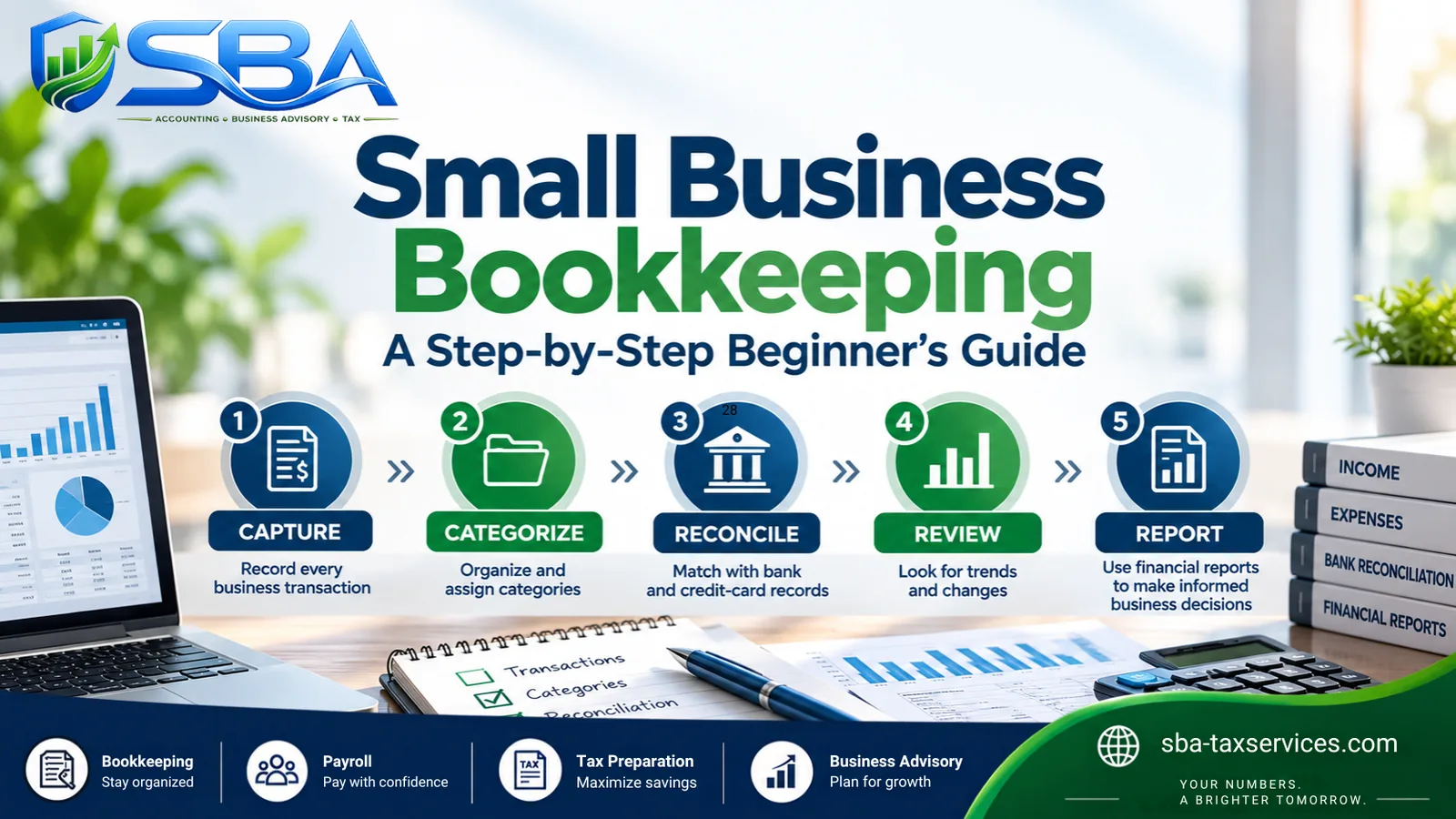
This guide explains a practical five-step bookkeeping workflow:
04 How often to do it 05 Software vs. spreadsheet 06 Checklist & next steps
What Is Small Business Bookkeeping?
Small business bookkeeping involves recording and organizing the financial activity of a business.
That activity can include:
- Sales and other business income
- Business expenses
- Customer payments
- Vendor payments
- Bank transactions
- Credit-card transactions
- Payroll-related transactions
- Business assets and liabilities
- Other financial transactions relevant to the business
More specifically, the IRS explains that business transactions are ordinarily summarized in books such as journals and ledgers. A business may use paper records or electronic accounting software, provided its system maintains complete and accurate records. See IRS guidance on recording business transactions.
In practical terms, bookkeeping turns individual transactions into organized financial information that the business owner can review.
Why Does Small Business Bookkeeping Matter?
As a result, good bookkeeping gives you a clearer view of your business finances.
According to the IRS, good records can help a business monitor its progress, prepare financial statements, identify sources of income, track deductible expenses, prepare tax returns, and support information reported on those returns.
Bookkeeping can also help you answer everyday business questions:
- How much did the business earn?
- What did the business spend?
- Which expenses are increasing?
- How much cash is available?
- Which customers still owe money?
- Which bills need to be paid?
- Is the business becoming more or less profitable?
As a result, the answers become more useful when the underlying records are organized and up to date.
The 5-Step Small Business Bookkeeping Process
01Step 1: Small Business Bookkeeping — Capture Every Transaction
To begin, the first step is to record the financial activity of the business.
For example, this includes both money coming into the business and money going out.
For example, you may need to record:
- Customer sales
- Service revenue
- Supplier purchases
- Office expenses
- Software subscriptions
- Advertising expenses
- Business travel
- Payroll transactions
- Bank fees
- Loan payments
The IRS recommends recording transactions when they occur and explains that recording transactions daily can be a good recordkeeping practice.
However, the goal is not simply to enter numbers. For that reason, each transaction should have enough information to explain what happened.
Keep Supporting Documents
In addition, your records should be supported by appropriate documentation.
The IRS lists documents such as sales slips, paid bills, invoices, receipts, deposit slips and canceled checks among records that can support transactions. See IRS Publication 583, Starting a Business and Keeping Records.
For example, a practical system might organize documents by:
- Date
- Vendor or customer
- Transaction type
- Account
- Payment method
- Related receipt or invoice
In addition, digital storage can make organization easier, but the important issue is maintaining complete and accessible records.
02Small Business Bookkeeping: Categorizing Income and Expenses
After transactions are captured, the next step is to put them into appropriate categories.
For example, expenses might be separated into categories such as:
- Advertising
- Office expenses
- Insurance
- Professional services
- Rent
- Utilities
- Software
- Travel
- Payroll
- Other applicable business expenses
However, the exact categories a business needs depend on its activities and accounting system.
Proper categorization matters because simply knowing how much money left the bank account does not explain why it left.
For example, suppose a business spent $2,000 during a month. That number alone does not tell the owner whether the money went toward advertising, equipment, payroll, software or other expenses.
In other words, categorization adds that context.
Keep Business and Personal Transactions Separate
A separate business account can make bookkeeping easier.
The U.S. Small Business Administration advises businesses to open a business bank account when they are ready to start accepting or spending money as a business. The IRS also notes that keeping business and personal accounts separate makes recordkeeping easier.
If a transaction is partly business and partly personal, the business and personal portions may need to be separated appropriately. The IRS notes that personal expenses generally are not deductible business expenses. See IRS Publication 334 for relevant guidance.
03Small Business Bookkeeping: Reconciling Your Accounts
However, recording transactions is only part of bookkeeping.
You should also compare your bookkeeping records with statements from financial institutions and investigate differences. This process is commonly called bank reconciliation.
For example, your accounting records might show one balance while the bank statement shows another. For example, differences can occur because of outstanding transactions, timing differences, fees, errors or transactions that have not yet been recorded.
Therefore, the purpose of reconciliation is to identify and resolve those differences.
The IRS discusses reconciling a business checking account as part of its recordkeeping guidance.
What Should You Compare?
Depending on your bookkeeping system, you may compare:
- Bank statements
- Credit-card statements
- Payment processor records
- Accounting-system transactions
- Deposits
- Withdrawals
- Outstanding checks
- Electronic payments
A regular reconciliation routine can make errors easier to identify while the transactions are still recent.
04Step 4: Review Your Financial Information
Next, once transactions are recorded, categorized and reconciled, take time to review the results.
Bookkeeping should not become a process where numbers are entered and then ignored.
Look for meaningful changes such as:
- Revenue increasing or decreasing
- Expenses changing significantly
- Unpaid customer invoices
- Bills coming due
- Changes in available cash
- Unusual transactions
- Repeated expenses
- Categories that are growing faster than expected
As a result, this review can help turn bookkeeping into a management tool.
For example, if advertising expenses increased significantly but sales did not change as expected, the owner may want to investigate further.
Likewise, if revenue is increasing but available cash remains tight, the owner may need to examine collections, payment timing and other cash-flow factors.
05Step 5: Prepare and Review Financial Reports
Finally, the process ends by turning organized bookkeeping data into useful financial information.
Income Statement
An income statement summarizes income and expenses for a specific period and helps show whether the business generated a profit or loss during that period. The IRS discusses income statements and other financial information in Publication 583.
Balance Sheet
A balance sheet presents assets, liabilities and equity at a particular point in time.
Cash Flow Information
Cash-flow information helps the owner understand cash coming into and going out of the business.
These reports provide different perspectives. Reviewing them together can give a business owner a more complete picture of financial activity.
For a deeper explanation, see SBA’s related guide: Financial Reports Every Small Business Owner Should Understand.
How Often Should You Do Small Business Bookkeeping?
There is no single schedule that works for every business. The appropriate frequency depends on factors such as transaction volume, business complexity, staffing and the bookkeeping system being used.
However, a practical routine can be organized like this:
Daily
- Capture new transactions
- Save receipts and invoices
- Record sales and expenses
- Identify unusual transactions
Weekly
- Review recent transactions
- Check outstanding customer payments
- Review upcoming bills
- Organize supporting documents
Monthly
- Reconcile bank and credit-card accounts
- Review financial reports
- Compare current results with previous periods
- Check accounts receivable and accounts payable
- Investigate unusual changes
The IRS notes that recording transactions daily is generally a good recordkeeping practice, while its guidance also describes daily and monthly summaries as examples of a small-business recordkeeping system. These are practical workflow suggestions, not a universal legal requirement for every business.
Small Business Bookkeeping Software or a Spreadsheet?
Small businesses can use different systems to organize their financial records.
The IRS does not require every business to use one particular recordkeeping format. Instead, businesses generally may choose a system suited to their operations that clearly shows income and expenses.
A Spreadsheet May Work When:
- Transaction volume is relatively low
- The business has straightforward activity
- The owner understands the bookkeeping process
- Records can be maintained consistently
Accounting Software May Help When:
- Transactions become more frequent
- Multiple accounts need to be tracked
- Invoices and bills need regular management
- Financial reports are needed
- Reconciliation needs to be performed regularly
- More than one person needs access to financial information
Electronic systems can be used for business recordkeeping when they maintain the necessary information and meet applicable recordkeeping requirements.
Ultimately, the important point is not simply which tool you choose. It is whether the system is used consistently and produces reliable records.
Common Small Business Bookkeeping Mistakes to Avoid
1. Mixing Personal and Business Transactions
Separate business and personal finances whenever appropriate. Mixing them can make the records harder to understand and complicate expense tracking.
2. Waiting Too Long to Record Transactions
When transactions accumulate, it becomes easier to overlook receipts, payments or other details.
3. Failing to Reconcile Accounts
A bookkeeping balance should not automatically be assumed to be correct. Reconciliation helps identify differences that need investigation.
4. Losing Supporting Documents
Receipts, invoices and other supporting documents help substantiate the transactions recorded in the books.
5. Treating Bookkeeping as a Once-a-Year Task
Bookkeeping is more useful when financial information is maintained throughout the year rather than reconstructed only when tax filing approaches.
What Records Should a Small Business Keep?
The specific records needed vary by business.
The IRS states that a business can generally choose a recordkeeping system suited to its operations, but the system must clearly show income and expenses.
Depending on the business, records may include:
- Sales records
- Invoices
- Receipts
- Bank statements
- Credit-card statements
- Deposit records
- Expense records
- Payroll records
- Asset records
- Loan documents
- Tax records
- Supporting documentation for reported transactions
The IRS also explains that records should generally be retained as long as they are needed to support applicable tax matters, and different rules can apply to particular records. For that reason, business owners should not assume that every document has the same retention period. See IRS recordkeeping guidance for the applicable details.
When Should You Consider Professional Bookkeeping Help?
A business owner may decide to handle bookkeeping personally, use accounting software, outsource the work, or combine these approaches.
Professional help may become useful when:
- Transactions become difficult to keep up with
- Bank reconciliation is regularly delayed
- Accounts receivable or payable need closer management
- Payroll creates additional administrative work
- Financial reports are difficult to understand
- The owner spends too much time maintaining the books
- Records need to be organized before tax preparation
- The business is growing and financial information needs to be more timely
The SBA discusses bookkeeping and accounting support as part of managing a business and identifies areas such as accounts receivable, accounts payable, available cash, bank reconciliation and payroll as functions that may need to be managed.
Small Business Bookkeeping Checklist
Every day or as transactions occur:
- Record income
- Record expenses
- Save receipts and invoices
- Identify unusual transactions
Each week:
- Review recent transactions
- Check customer payments
- Review upcoming bills
- Organize financial documents
Each month:
- Reconcile bank accounts
- Reconcile credit-card accounts
- Review income and expenses
- Review accounts receivable
- Review accounts payable
- Review financial reports
- Investigate unusual changes
Throughout the year:
- Keep business and personal finances appropriately separated
- Maintain supporting documentation
- Keep financial records organized
- Review the bookkeeping process as the business grows
Final Thoughts
Small business bookkeeping does not have to be complicated to be useful.
A consistent process can help you capture transactions, categorize financial activity, reconcile accounts, review what the numbers are telling you, and prepare useful financial reports.
The key is consistency.
Instead of waiting until tax time to reconstruct months of financial activity, build bookkeeping into your regular business routine. Good records can make it easier to understand the business, prepare financial information and support tax reporting.
If your bookkeeping is becoming difficult to maintain, professional support can help you establish a more organized process and keep your financial information up to date.
SBA Accounting and Tax Services PLLC provides bookkeeping, accounting, payroll, tax preparation and business advisory services designed to help small businesses stay organized and make informed financial decisions.





One Response