
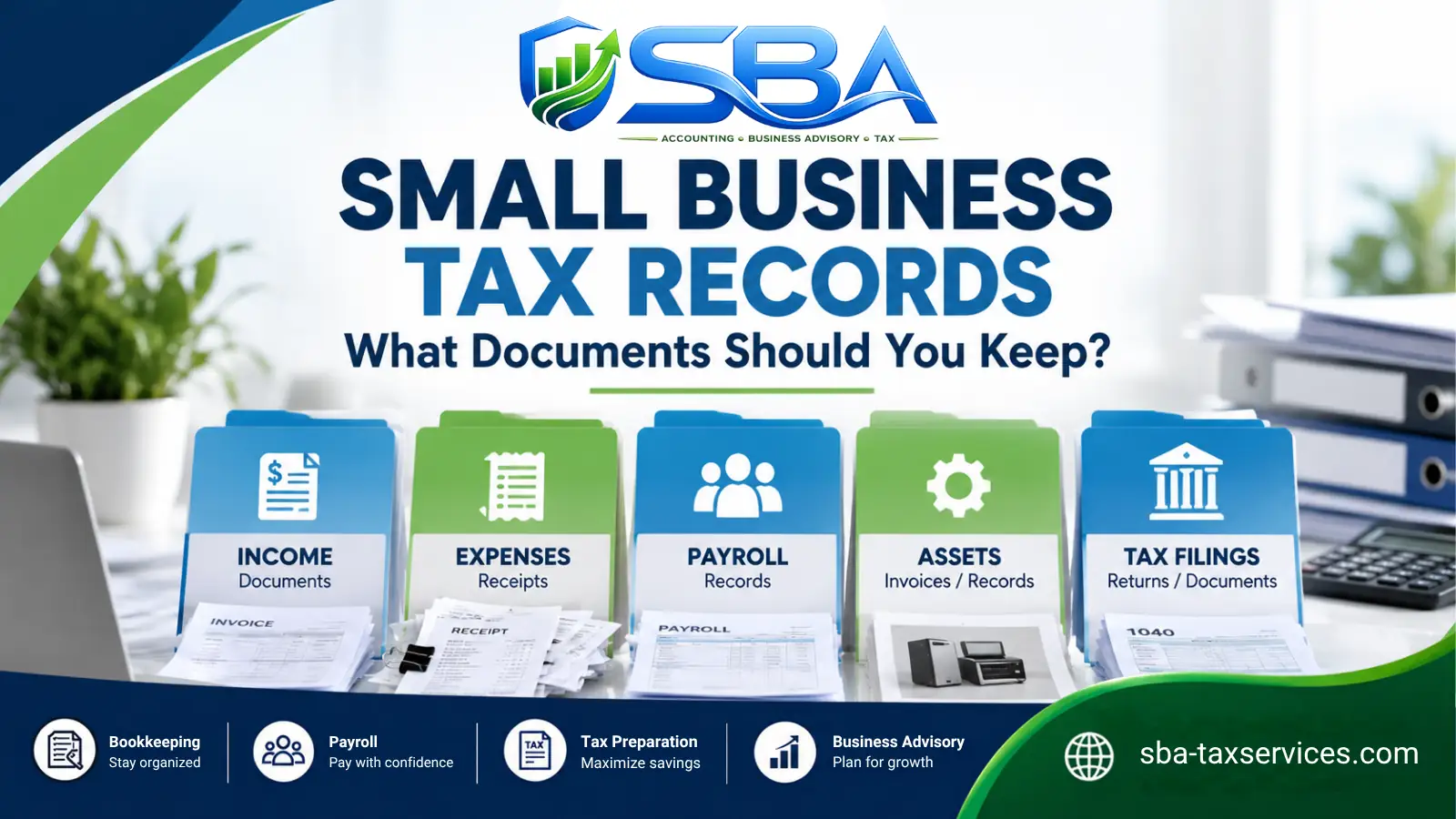
Running a small business means keeping small business tax records for income, expenses, payroll, assets and tax filings. Invoices, receipts, bank statements, payroll records, payment reports and tax filings can quickly become difficult to organize.
However, keeping small business tax records is about more than putting paperwork into a folder. Good records help you understand business activity, prepare tax returns, support reported income and expenses, and respond to questions about your tax filings.
A useful business recordkeeping system should make it easy to identify income, document expenses, track important business assets, organize payroll information and locate the records supporting your tax filings.
In This Guide
What Are Small Business Tax Records?
Small business tax records are the documents and accounting information that help establish the income, expenses, assets, payments and other transactions reported by your business.
For example, the IRS explains that supporting documents may include sales slips, paid bills, invoices, receipts, deposit slips and canceled checks. For more detail, review the IRS recordkeeping guidance. These records support entries in your books and the information you report on your tax return.
Importantly, there is not one universal recordkeeping format that every business must use. The IRS states that businesses may choose a system suited to their operations, provided it clearly shows income and expenses.
- Consistent
- Easy to maintain
- Easy to search
- Connected to your bookkeeping
- Organized by business year and record type
- Supported by appropriate documentation
What Income Records Should a Small Business Keep?
Your income records should help you identify how much money the business received and where that money came from.
- Customer invoices
- Sales receipts
- Bank statements
- Deposit records
- Credit-card processing statements
- Payment-platform reports
- Applicable information returns such as Forms 1099
- Other records showing the source and amount of business income
Why Income Documentation Matters
It is important to distinguish business income from other deposits that may appear in a business bank account. For instance, a deposit might represent a customer payment, an owner contribution, a loan or another type of transaction. Consequently, simply looking at the bank balance may not tell the complete story.
Do not rely on memory to explain transactions months later. Record the business purpose and supporting documentation as close to the transaction as practical.
What Expense Records Should You Keep?
In addition, expense documentation helps establish what your business paid, how much it paid and why the payment was made.
- Vendor invoices
- Receipts
- Paid bills
- Business credit-card statements
- Bank statements
- Canceled checks
- Payment confirmations
- Account statements
The IRS notes that supporting documents should substantiate business expenses and generally provide information showing the amount paid and that the payment was for a business expense. However, a bank or credit-card statement by itself may not always explain the complete business purpose. Therefore, retaining the underlying invoice or receipt can provide important context. For a broader look at organizing business expenses, see Business Expenses: What to Track and Why Accurate Records Matter.
Organize Expenses by Type
In practice, you can group expenses into categories that match your bookkeeping structure.
- Office expenses
- Advertising and marketing
- Professional services
- Insurance
- Rent or lease costs
- Software and subscriptions
- Travel and transportation
- Business supplies
- Equipment
What Payroll Records Should Your Business Keep?
If your business has employees, payroll records also become another important part of your tax-record system.
- Wage and payment records
- Payroll reports
- Employee withholding information
- Forms W-2 and W-2c
- Filed employment-tax returns
- Tax-deposit records
- Records of benefits and reimbursements
- Documentation supporting applicable payroll tax credits
The IRS states that employers generally need to keep employment-tax records for at least four years after the applicable filing period. Therefore, keep payroll documentation organized throughout the year. Because payroll records can contain sensitive employee information, store them securely and limit access appropriately.
What Business Asset Records Should You Keep?
Similarly, business assets can require a different level of documentation. Examples may include equipment, machinery, furniture, vehicles and certain technology or other property used by the business.
For these assets, keep records that establish what you purchased, when you acquired it, the purchase price, related improvements, how you used the asset, depreciation information and when and how you disposed of it.
The IRS explains that property records can help you determine depreciation, basis and gain or loss when you dispose of property.
Do not treat an asset purchase like an ordinary recurring expense without checking how it should be recorded. Instead, make sure your bookkeeping system properly identifies the purchase and that you retain the supporting documentation.
What Tax Returns and Filing Records Should You Keep?
Your recordkeeping system should also include copies of tax returns and related filing documentation.
- Filed federal tax returns
- Applicable state and local tax returns
- Information returns
- Payroll tax filings
- Sales-tax filings where applicable
- Tax payment confirmations
- Estimated-tax payment records
- Supporting schedules
- Documents used to prepare the returns
Additionally, keep copies of filed returns because they can help with future returns and other tax computations. Additionally, keeping the documents used to prepare a return can make it easier to understand how reported amounts were determined.
How Long Should You Keep Small Business Tax Records?
Importantly, this is one of the most common recordkeeping questions. There is not one universal retention period for every business document.
Instead, the appropriate period depends on what the record relates to and the circumstances involved. The IRS explains that records generally need to be kept as long as necessary to prove the income or deductions shown on a tax return.
For federal income-tax records, the IRS lists different periods depending on the situation. Therefore, review the applicable period before disposing of records. Ordinary circumstances often involve a three-year period, while certain situations require longer retention. Property-related records may need to be kept until the applicable period expires for the year in which the property is disposed of. Employment-tax records generally require at least four years. See the IRS record-retention guidance for the current federal rules.
Therefore, do not apply a blanket “three-year rule” to every business document. Record-retention requirements vary by record type and circumstances. Check applicable federal, state and local requirements before destroying records.
Build a Simple Business Tax Recordkeeping System
You do not necessarily need a complicated filing structure. Instead, consider creating several primary folders.
1. Income
Store records supporting money received by the business.
2. Expenses
Store invoices, receipts and other documentation supporting business expenses.
3. Payroll
Keep employee payroll and employment-tax documentation together.
4. Assets
Maintain purchase and supporting documentation for business property.
5. Tax Filings
Keep filed returns, payment confirmations and related supporting documents.
6. Banking and Payment Platforms
Keep statements and reports that help reconcile business transactions.
A simple structure can then be organized by year. For example: 2026 → Income → Expenses → Payroll → Assets → Tax Filings → Banking. The exact structure can vary. Nevertheless, consistency matters more than creating a complicated filing hierarchy. Also, review the system regularly.
How Bookkeeping Supports Tax Recordkeeping
Tax records and bookkeeping work together. In practice, your records provide supporting documentation, while your bookkeeping system organizes the financial transactions those documents support.
For example, a customer invoice may support a revenue entry. Similarly, a vendor receipt can support an expense transaction. That connection becomes particularly useful when preparing tax returns because accounting records can provide a structured view of business activity.
If your business needs stronger day-to-day financial organization, consider reviewing SBA Bookkeeping Services as part of your overall recordkeeping process.
When Should You Review Your Tax Records?
Recordkeeping should not be limited to tax season. Instead, review your records throughout the year.
- Are all business bank accounts reconciled?
- Are income transactions properly identified?
- Are expenses supported by appropriate documents?
- Are payroll records complete?
- Are asset purchases properly documented?
- Are tax payments recorded?
- Are important filing confirmations saved?
- Are digital records backed up?
- Can you quickly locate documentation supporting a significant transaction?
As a result, regular reviews can make tax preparation more orderly because you can identify missing records earlier. For broader planning considerations, review SBA’s Business Tax Planning guide and What Is Business Tax Advisory, and When Might You Need It?.
A Practical Small Business Tax Records Checklist
Income
- Invoices
- Sales receipts
- Bank deposits
- Payment processor reports
- Applicable Forms 1099
Expenses
- Vendor invoices
- Receipts
- Paid bills
- Bank and credit-card statements
- Payment confirmations
Payroll, Assets and Tax Filings
- Payroll reports and wage records
- Employment-tax filings and deposit confirmations
- Asset purchase and depreciation documentation
- Filed returns and supporting schedules
- Estimated-tax payment records
Questions to Ask When Reviewing Your Records
- Can I identify every major source of business income?
- Can I support the expenses recorded in my books?
- Can I locate documentation for significant asset purchases?
- Are payroll records complete and securely stored?
- Do I have copies of filed tax returns and payment confirmations?
- Can I explain unusual or significant transactions?
- Are my digital records backed up?
Frequently Asked Questions
What records should a small business keep for taxes?
Generally, a business should maintain records that support income, expenses, assets, payroll and tax filings. Examples include invoices, receipts, bank records, payment records, payroll documentation and copies of filed returns.
How long should a small business keep tax records?
There is no single retention period for every document. The appropriate period depends on the record type and circumstances. Federal guidance includes different periods for different situations.
Should I keep digital copies of business tax records?
Digital recordkeeping can be part of a business recordkeeping system. However, records should preserve the information needed to substantiate transactions and should be backed up appropriately.
Do I need receipts for every business expense?
Supporting documentation is important for substantiating business expenses. However, the documentation you need can depend on the type of expense and applicable tax rules.
What if I am missing records?
Start by identifying which transactions or tax items are affected. Then determine what replacement documentation may be available, such as bank statements, invoices, payment-platform reports or duplicate vendor records. For significant issues, professional guidance may be appropriate.
How SBA Can Help
Organized records provide the foundation for more efficient bookkeeping, tax preparation and business tax planning.
SBA Accounting and Tax Services PLLC can help small-business owners with bookkeeping, payroll, sales tax, tax preparation and tax advisory support.
If your records have become difficult to organize, review SBA Bookkeeping Services. For businesses thinking beyond filing season, Business Tax Advisory Services can provide a starting point for discussing tax-related questions and planning considerations.
READY TO GET YOUR BUSINESS RECORDS ORGANIZED?
A consistent recordkeeping system can make it easier to understand your business finances and prepare for tax-related responsibilities.
Contact SBA Accounting and Tax Services PLLC to discuss your bookkeeping, tax preparation or business tax advisory needs.
Final Thoughts
Good small business tax records do more than support a tax return. They help create a clearer financial history of the business and can make it easier to identify income, document expenses, monitor business activity and prepare financial information throughout the year.
Most importantly, recordkeeping works best as an ongoing process rather than a last-minute tax-season project. Therefore, start with a system your business can maintain consistently. Organize income, expenses, payroll, assets and tax filings. Then review the system regularly so missing documentation can be addressed before it becomes a larger problem.
Better records today can make tomorrow’s tax and financial decisions easier to manage.
General educational information only. Recordkeeping and tax requirements can vary by tax year, business structure and jurisdiction. Review current federal, state and local requirements and seek qualified professional advice for your specific circumstances.


One Response