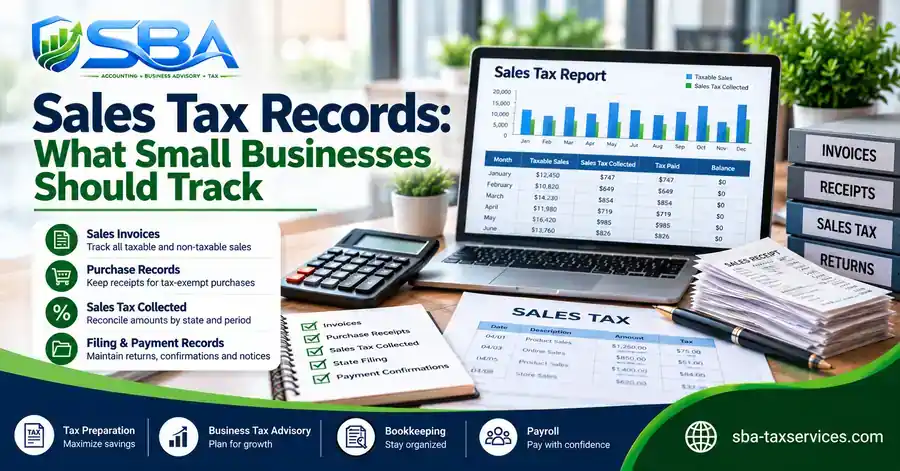
Sales tax records help small-business owners understand what they sold, how much tax they collected, which transactions may be exempt, and what they reported to tax authorities. However, keeping sales receipts alone is not enough. A reliable recordkeeping process should connect individual transactions with supporting documents, accounting reports, filed returns, and payment confirmations.
For that reason, make sales tax recordkeeping part of your regular bookkeeping routine instead of waiting until a filing deadline approaches. With organized records, you can review sales activity, investigate discrepancies, prepare returns more confidently, and respond more efficiently when questions arise. The specific requirements vary by jurisdiction, so your system should also make it easy to identify which location’s rules apply.
In This Guide
Jump to the section you need. Each item opens the matching part of this article.
02Which Records Should You Track?↗
03How to Organize Records↗
04How Long Should You Keep Records?↗
05Common Recordkeeping Mistakes↗
06Sales Tax Records Checklist↗
07Frequently Asked Questions↗
What Are Sales Tax Records?
In practical terms, sales tax records are the documents and accounting information that help explain how a business calculated, collected, reported, and paid applicable sales or use taxes. More importantly, they provide the evidence behind the figures included in a sales tax return.
For example, records may include sales receipts, invoices, point-of-sale reports, tax calculation details, exemption documentation, filed returns, and payment confirmations. Taken together, these materials help you trace a reported amount back to the transactions that created it. They can also help explain why a transaction was treated as taxable, exempt, or otherwise handled under a particular rule.
Sales tax requirements differ across states and local jurisdictions. Therefore, keep enough detail to identify the location and tax treatment relevant to each transaction. The U.S. Small Business Administration’s tax guidance is a useful starting point, but consult the applicable state or local tax authority for specific sales tax requirements.
Which Sales Tax Records Should Small Businesses Track?
To begin, the right record set depends on your business model, the jurisdictions where you operate, and the transactions you make. Nevertheless, the following categories form a practical starting point for many small businesses.
1. Sales receipts, invoices, and transaction details
For each sale, retain sales receipts and invoices with transaction dates, amounts, items or services sold, customer details where appropriate, and tax charged. In addition, keep point-of-sale or ecommerce reports that summarize sales over a reporting period. These records help connect individual sales with the totals in your accounting system and tax return.
2. Taxability decisions and location information
Equally important, keep records that explain how you determined whether a sale was taxable and which jurisdiction applied. Depending on your business, useful details may include the ship-to address, point-of-sale location, product or service category, and tax calculation report. This matters especially for businesses that sell online or across state lines because tax obligations and sourcing rules can vary.
3. Exemption certificates and supporting documents
When you treat a sale as exempt, retain the documentation that the relevant jurisdiction requires. In particular, keep the evidence with the transaction record it supports. For example, certain resale transactions may require a valid resale certificate or other prescribed evidence. However, documentation rules vary, so confirm which information must be collected, how it should be completed, and when it must be updated.
4. Sales tax returns and payment confirmations
For every filing period, save your filed returns and schedules, acknowledgements, payment receipts, and account notices. Furthermore, retain the calculations used to prepare each return. These documents let you confirm what you reported, when you submitted it, and whether the payment went through.
5. Refunds, credits, and adjustments
Returns, canceled orders, discounts, and corrections can change the amounts reported. Keep the original transaction record along with the credit, refund, or adjustment documentation. As a result, you can explain how the original sale was changed and how the change was reflected in your books or return.
6. Registration details and tax authority correspondence
Keep your registration confirmations, sales tax account numbers, permits or certificates, filing frequency notices, and correspondence from tax authorities. In addition, record changes to your business locations, ownership, or sales channels when those changes affect registration or reporting obligations.
How to Organize Sales Tax Records
A useful system should make it easy to locate a document and connect it to a transaction, reporting period, and jurisdiction. For that reason, consistency matters more than a complicated folder structure. You do not necessarily need a complicated platform. Instead, you need a consistent process that people in your business can follow.
- Group by jurisdiction. Separate records by state or local account when you have obligations in more than one place.
- Group by filing period. Use consistent month, quarter, or other assigned reporting-period folders.
- Keep supporting records together. Store sales summaries, tax calculations, exemption documents, returns, and payment confirmations with the relevant period.
- Use clear filenames. Include a date or period, document type, and jurisdiction where useful.
- Restrict access and back up files. Keep sensitive information secure and ensure records remain retrievable if a device or account fails.
After organizing the files, reconcile the sales system with your accounting records before preparing a return. Compare gross sales, taxable sales, exempt sales, tax collected, refunds, and adjustments. Then investigate differences rather than forcing the totals to match. As a result, a documented reconciliation gives you a clear explanation for the amounts you report.
For a broader process to keep transactions and reports organized, see SBA’s bookkeeping services. You can also review the related guide, Sales Tax for Small Businesses: A Beginner’s Guide, for the wider registration, collection, filing, and remittance workflow.
How Long Should You Keep Sales Tax Records?
Importantly, there is no single retention period that should be assumed for every sales tax record in every jurisdiction. The required period can vary by tax authority, record type, return, and circumstances. Therefore, check the current instructions for each relevant jurisdiction and apply the longest applicable requirement to records that support multiple obligations.
As a practical safeguard, do not destroy supporting documents just because you filed or paid a return. Keep the records for the period the relevant authority requires, and consider whether an audit, notice, refund claim, or other unresolved matter means you should retain them longer. If you are unsure about the requirements, ask the tax authority or a qualified tax professional before disposing of records.
Common Sales Tax Recordkeeping Mistakes to Avoid
Nevertheless, even businesses that save their receipts can have gaps in their supporting records. Watch for these recurring issues:
- Keeping receipts but not tax reports: transaction receipts alone may not explain how the return totals were calculated.
- Mixing jurisdictions: combining locations without clear detail can make it harder to apply and verify the correct rules.
- Missing exemption evidence: an exempt-sale label is not a substitute for documentation required by the relevant jurisdiction.
- Ignoring refunds and adjustments: changes should be documented and reflected consistently in accounting and tax reports.
- Failing to reconcile: unexplained differences between sales reports, tax collected, and returns can remain undetected.
- Deleting records too early: retention periods differ, so confirm the applicable requirements before disposal.
To reduce these risks, assign responsibility for collecting records, reviewing reconciliations, filing returns, and saving confirmations. In addition, schedule a regular review so missing documents are identified before the next filing deadline.
Sales Tax Records Checklist for Small Businesses
Use this checklist during your monthly or assigned filing-period review. Adapt it to your business and confirm any jurisdiction-specific requirements.
- Sales invoices, receipts, and transaction reports are saved.
- Taxability and relevant location details can be traced.
- Required exemption certificates or supporting documents are retained.
- Sales, taxable sales, exempt sales, tax collected, refunds, and adjustments have been reconciled.
- Filed returns, payment confirmations, and tax authority notices are stored.
- Registration information and filing deadlines are current.
- You have backed up records, limited access appropriately, and checked retention rules.
Finally, document any unresolved difference and who will follow up. A short note explaining an adjustment is often more useful than an unexplained number discovered months later.
Frequently Asked Questions About Sales Tax Records
What sales tax records should a small business keep?
Common records include invoices and receipts, transaction reports, tax calculation details, exemption documentation where required, filed returns, payment confirmations, refund records, registration information, and relevant tax authority correspondence. The exact requirements vary by jurisdiction.
Do I need to keep exemption certificates?
When you classify a transaction as exempt and the jurisdiction requires supporting documentation, keep the applicable certificate or other required evidence. Check the tax authority’s rules for validity, completion, and retention.
Can I store sales tax records digitally?
Digital storage can make records easier to search and organize. However, keep every record readable, secure, complete, and accessible when needed. Confirm the relevant authority’s requirements and keep suitable backups.
How often should I review sales tax records?
For many businesses, a regular monthly review is a useful operating habit even if the assigned filing frequency differs. At a minimum, reconcile records before each required return and review the process when your products, sales channels, locations, or tax obligations change.
What should I do if records do not match my return?
Investigate the difference before making an unsupported adjustment. Compare sales reports, tax calculations, refunds, exemptions, accounting entries, and payment records. Document the resolution and follow the relevant tax authority’s correction process if an already-filed return needs to be amended.
Build a Reliable Sales Tax Recordkeeping Process
Ultimately, good sales tax records are not just a folder of receipts. They form a traceable record of what the business sold, how transactions were treated, what tax was reported, and when payments were made. By organizing records by jurisdiction and period, reconciling them consistently, and retaining supporting documents, you can make your filing routine more reliable.
Most importantly, confirm the rules that apply to your business. Taxability, exemption documentation, filing requirements, and retention periods can vary by jurisdiction and change over time. Use current official guidance, and seek qualified tax advice when your situation involves multiple states or an unclear requirement.
Make Your Sales Tax Records Easier to Manage
SBA Accounting and Tax Services PLLC supports small businesses with bookkeeping and business tax advisory services to help keep financial information organized.
Explore the service options that fit your business needs.
Explore Our Bookkeeping Services
You can also review Business Tax Advisory Services or the sales tax beginner’s guide.
This article provides general educational information and is not a substitute for advice about your specific tax obligations. Sales tax rules vary by jurisdiction and can change; confirm current requirements with the appropriate tax authority or a qualified tax professional.