
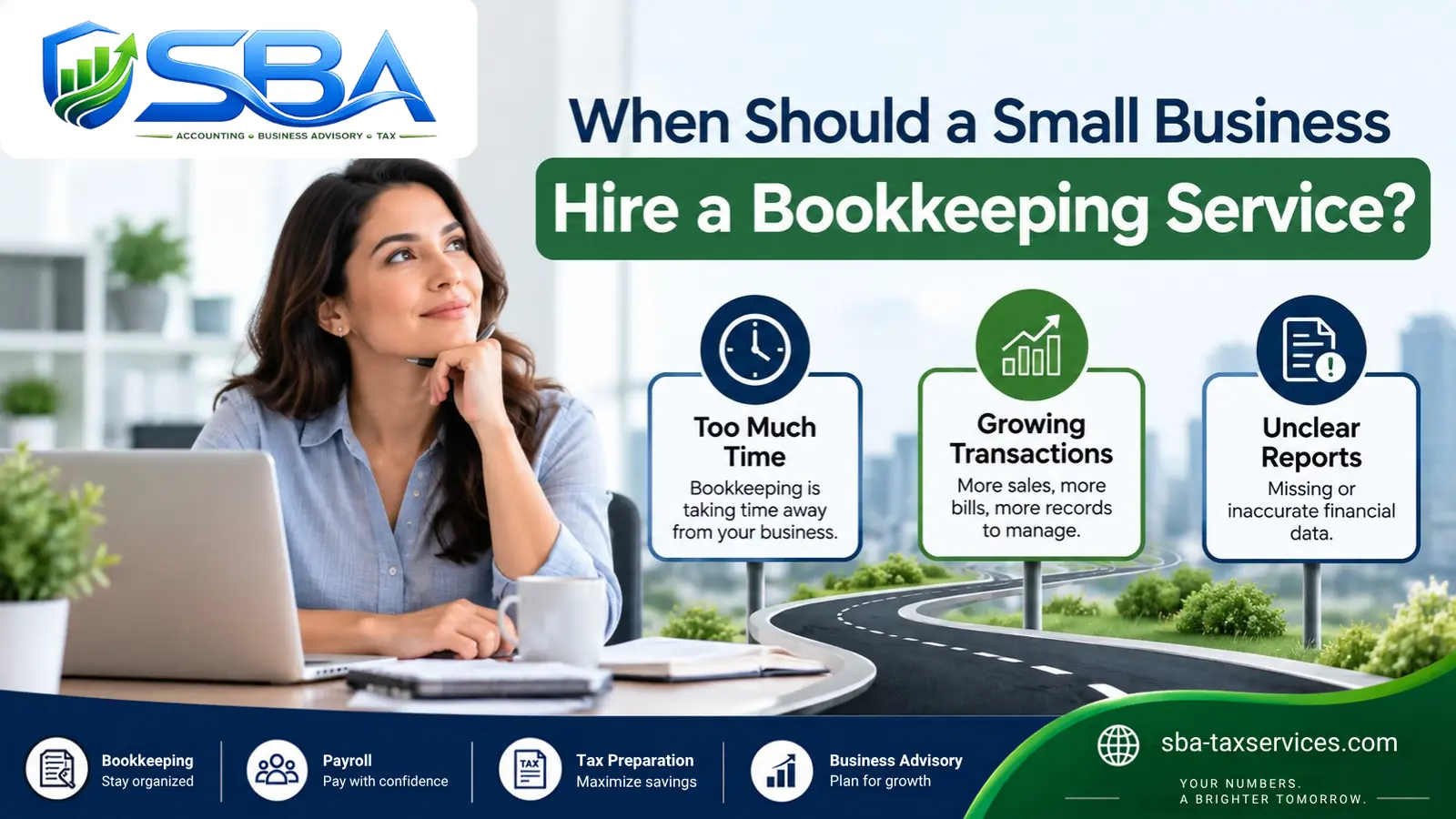
Knowing when to hire a bookkeeping service is less about reaching a particular sales number and more about recognizing when your current bookkeeping process no longer gives you the time, accuracy, or financial visibility your business needs.
At first, many small-business owners handle their own books because the transaction volume is manageable. However, as a business grows, bookkeeping can become harder to keep current while the consequences of delayed or incomplete records become more significant.
Therefore, the right time to bring in bookkeeping support is often when bookkeeping starts competing with important business responsibilities, financial reports become difficult to trust, or the business becomes more complex.
The SBA emphasizes understanding business finances and maintaining sound financial management as part of managing a business. Likewise, IRS guidance stresses the importance of complete and accurate records that clearly show income and expenses.
- Your bookkeeping is taking too much time
- Your number of transactions has increased
- Your financial reports are late or unclear
- Bank reconciliation is falling behind
- Your business has become more financially complex
- You are mixing business and personal financial activity
- You are preparing for growth, financing, or major decisions
- Tax preparation has become a catch-up exercise
- You are losing visibility into your business
- What a bookkeeping service can help with
- When DIY bookkeeping may still make sense
- A simple bookkeeping capacity check
- Questions to ask before hiring a bookkeeping service
- How much does a bookkeeping service cost?
- Frequently Asked Questions
1. When to Hire a Bookkeeping Service: Your Bookkeeping Is Taking Too Much Time
If bookkeeping regularly takes you away from sales, customers, operations, or leadership, that time has a business cost.
Of course, some owner involvement can be useful. Nevertheless, there is a difference between reviewing your finances and spending hours every week entering transactions, correcting classifications, chasing missing information, and trying to reconcile accounts.
As a result, one of the clearest signs that you may need support is that bookkeeping has become a recurring source of unfinished work.
2. Your Number of Transactions Has Increased
More customers, vendors, employees, payment methods, subscriptions, and business expenses can make bookkeeping substantially more demanding.
For example, a business may eventually have activity spread across multiple bank accounts, credit cards, payment platforms, payroll systems, and sales channels.
That does not automatically mean you must outsource bookkeeping. However, increasing transaction volume raises the importance of a consistent process.
If transactions are beginning to pile up faster than you can record and review them, it may be time to hire a bookkeeping service.
3. When to Hire a Bookkeeping Service for Late or Unclear Financial Reports
Financial reports are most useful when they are available in time to support decisions.
If your income statement, balance sheet, or other reports are consistently delayed, you may be managing the business using information that is already outdated.
Moreover, a report that exists but is difficult to understand may not provide much practical value.
Reliable bookkeeping can provide a stronger foundation for financial reporting. Our guide to Small Business Financial Reports explains how common reports can help owners review business performance.
4. Bank Reconciliation Is Falling Behind
Bank reconciliation helps compare bookkeeping records with actual bank activity.
When reconciliations are repeatedly postponed, errors, missing transactions, duplicate entries, or unexplained differences can remain unresolved.
Therefore, falling behind on reconciliations is more than an administrative inconvenience. It can make the financial information you rely on less dependable.
For a practical explanation, see How to Reconcile Your Business Bank Account.
5. Your Business Has Become More Financially Complex
Growth can introduce new bookkeeping requirements even when revenue is not the only thing changing.
You may have added employees, contractors, inventory, multiple locations, new payment systems, loans, equipment, recurring subscriptions, or additional business accounts.
Consequently, bookkeeping that worked well when the business was smaller may no longer be sufficient.
The IRS explains in Publication 583 that businesses need a recordkeeping system suited to their operations and records that clearly show income and expenses.
6. You Are Mixing Business and Personal Financial Activity
Separating business and personal financial activity is an important bookkeeping discipline.
If personal purchases, transfers, or other activity regularly move through business accounts, classification becomes harder and financial reports can become less useful.
In addition, mixed activity can make it harder to identify the true financial performance of the business.
Therefore, if separating transactions has become a recurring problem, bookkeeping support may help establish a more consistent process.
7. When to Hire a Bookkeeping Service for Growth, Financing, or Major Decisions
Sometimes the right time to hire a bookkeeping service is before a major financial event rather than after a problem develops.
For example, you may be considering hiring employees, purchasing equipment, expanding operations, seeking financing, changing pricing, or entering a new market.
In those situations, current financial records can provide useful context for evaluating the decision.
However, bookkeeping does not guarantee that a decision will succeed. Instead, it helps give you organized financial information to consider alongside other business factors.
8. Tax Preparation Has Become a Catch-Up Exercise
Tax preparation becomes harder when bookkeeping is incomplete or delayed throughout the year.
Rather than reviewing organized records, you may find yourself reconstructing transactions, locating receipts, classifying expenses, and trying to remember what happened months earlier.
The IRS states that businesses should keep records that support income, expenses, and items reported on tax returns. Therefore, maintaining organized records throughout the year can make the tax process more manageable.
Bookkeeping is not the same as tax preparation, but dependable bookkeeping can make tax-related work more organized.
9. You Are Losing Visibility Into Your Business
Perhaps the strongest sign that you need bookkeeping support is that you no longer have a clear answer to basic financial questions.
Can you explain why expenses increased? Do you know which bills are outstanding? Can you review recent financial performance without reconstructing the books first?
If those questions are difficult to answer, the issue may not be the absence of data. Instead, the problem may be that the data is not being organized and reviewed consistently.
That is why accurate bookkeeping can support better financial visibility and more informed management.
What Can a Bookkeeping Service Help With?
The exact scope varies by provider and engagement. Generally, bookkeeping support may include:
- Recording and categorizing business transactions
- Bank and credit-card reconciliation
- Organizing financial records
- Maintaining accounts payable or receivable records
- Preparing routine financial reports
- Helping maintain bookkeeping consistency throughout the year
Depending on the provider, bookkeeping may also be coordinated with payroll, sales tax, tax preparation, or advisory services.
For broader guidance on managing business finances, see SBA Manage Your Business.
When DIY Bookkeeping May Still Make Sense Before You Hire a Bookkeeping Service
Hiring support is not automatically the right answer for every small business.
If your transaction volume is modest, your accounts are simple, you understand your bookkeeping system, and you can keep records current without interfering with core business responsibilities, DIY bookkeeping may still be practical.
Even then, however, it is important to maintain a consistent process and review your records regularly.
As the business changes, reassess the arrangement rather than assuming the original system will work indefinitely.
A Simple Bookkeeping Capacity Check
Use the following framework as a practical starting point.
GREEN — Your current process is working.
Books are current, reconciliations are performed, reports are understandable, and bookkeeping does not regularly interfere with important business responsibilities.
YELLOW — Your capacity is being stretched.
Transactions are accumulating, reports are delayed, reconciliations take longer, or bookkeeping is competing with other priorities.
RED — You need a more reliable process.
Books are substantially behind, financial information is difficult to trust, tax preparation requires major reconstruction, or you are making important decisions without current records.
If you are consistently in the yellow or red range, it may be time to evaluate whether you should hire a bookkeeping service.
Questions to Ask Before Hiring a Bookkeeping Service
Before choosing a provider, clarify what you actually need.
- What bookkeeping tasks will the service handle?
- How often will the books be updated?
- How will bank and credit-card reconciliations be handled?
- What financial reports will be provided?
- What bookkeeping software or systems will be used?
- How will questions and missing information be handled?
- Does the service coordinate with my tax professional when appropriate?
- What is included in the monthly fee, and what is billed separately?
Moreover, ask how the provider approaches accuracy, documentation, communication, and deadlines. The cheapest service is not necessarily the best fit if the process does not provide the reliability your business needs.
How Much Does a Bookkeeping Service Cost?
There is no single price that applies to every small business.
Pricing can depend on transaction volume, the number of accounts, the complexity of the business, the services included, the bookkeeping system, and the frequency of work.
Therefore, compare providers based on the scope of work rather than looking only at a monthly price.
Ask for a clear description of what is included, what is excluded, how catch-up work is handled, and whether additional services carry separate fees.
Frequently Asked Questions
When should a small business hire a bookkeeping service?
A small business should consider hiring a bookkeeping service when bookkeeping is taking too much owner time, transactions have grown, reconciliations are falling behind, financial reports are unclear or delayed, or the business needs more reliable financial information for planning and decisions.
Is it better to hire a bookkeeper before the books fall behind?
Often, yes. Bringing in support before records become substantially outdated can reduce the amount of catch-up work required and help establish a more consistent process.
Can a bookkeeping service help with tax preparation?
Bookkeeping and tax preparation are different services. However, organized and accurate bookkeeping can provide the financial records and supporting documentation needed to make tax preparation more organized.
Should I keep doing my own bookkeeping if my business is small?
You can if your bookkeeping remains manageable, accurate, and current. However, reassess as transaction volume, complexity, or business demands increase.
Final Thoughts
There is no universal moment when every small business should hire bookkeeping help.
Instead, the right time is often revealed by the condition of your bookkeeping process. If records are current, reconciled, understandable, and useful for decision-making, your existing approach may still be working.
However, if bookkeeping is consuming too much time, falling behind, becoming more complex, or limiting your financial visibility, professional support may be worth evaluating.
Ultimately, the goal is not simply to get the books done. The goal is to maintain financial information that helps you manage the business with greater confidence.
Need Reliable Bookkeeping Support?
If your business needs help keeping financial records organized, current, and useful for year-round decision-making, SBA Accounting and Tax Services PLLC can help you evaluate the bookkeeping support that fits your business.