
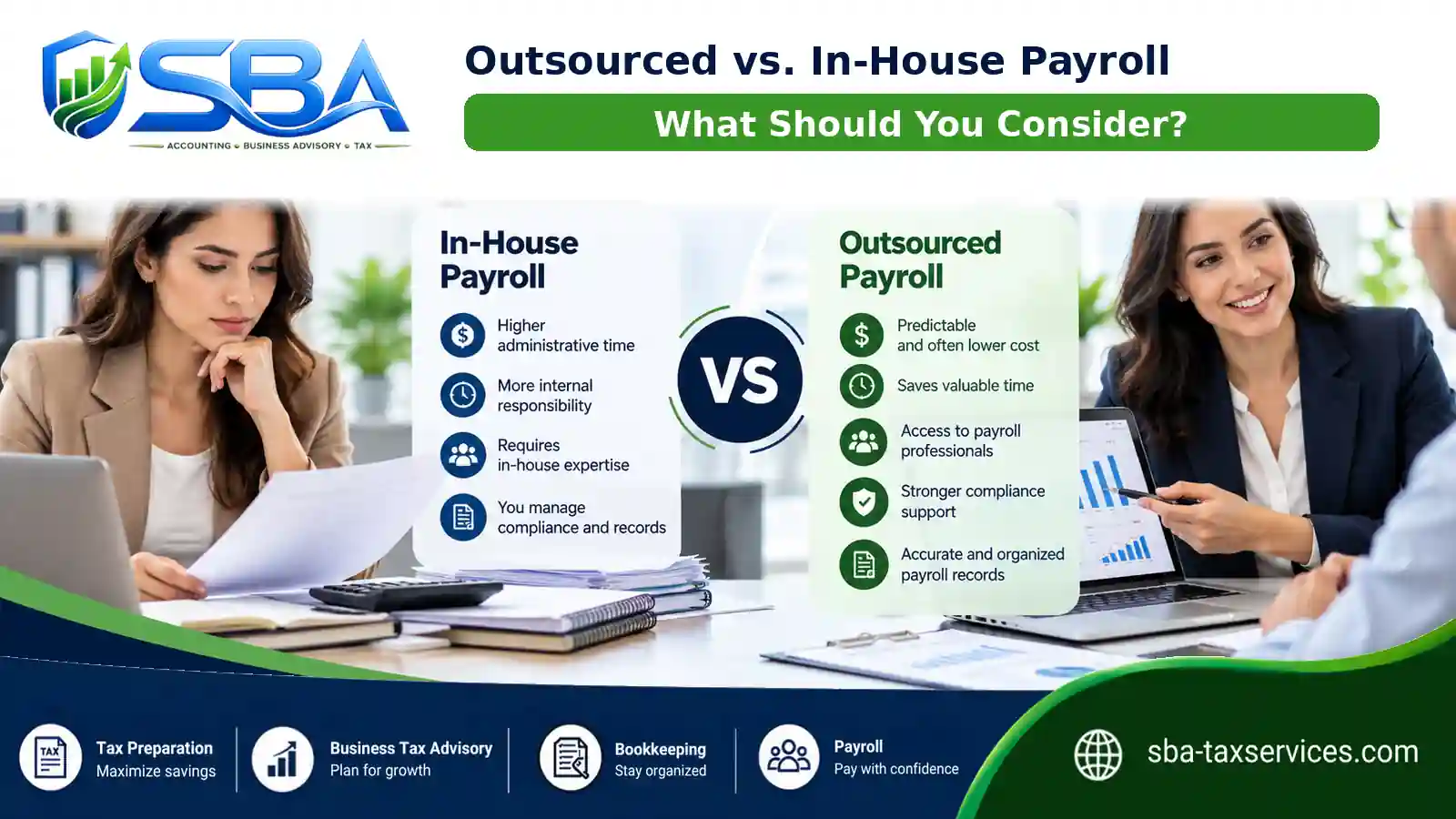
Outsourced vs in house payroll is an important decision for a small business. Your choice affects more than payday: it can influence how your team spends its time, how employee information is managed, how payroll connects with bookkeeping, and how your business monitors tax obligations. An in-house process gives your business direct control over payroll tasks. By comparison, an outsourced arrangement can move some recurring work to an outside provider. However, neither option automatically guarantees accuracy or compliance. Therefore, the right approach depends on your workforce, internal expertise, budget, systems, and ability to review payroll consistently.
In this guide, we compare both options, explain the main trade-offs, and provide a practical checklist to help you choose. We also explain why outsourcing payroll does not necessarily transfer every employer responsibility to a service provider.
02 What outsourced payroll means
03 Compare the main differences
04 Costs, time, expertise, and oversight
05 Payroll taxes, security, and bookkeeping
06 Decision checklist and FAQs
What Is In-House Payroll?
In-house payroll means your business manages payroll activities internally, using employees, accounting staff, management, payroll software, or a combination of these resources. Depending on your setup, the process may include collecting employee information, tracking hours, calculating wages, reviewing deductions, issuing payments, handling payroll tax deposits and filings, and maintaining records.
In addition, your business must coordinate payroll with its accounting process. Wage expenses, employer payroll taxes, deductions, and payments need to be recorded appropriately. In-house payroll may be worth considering when:
- Your payroll is relatively straightforward.
- Someone on your team has the necessary knowledge and time.
- You want direct access to payroll information and processing.
- You have a reliable system for checking calculations and deadlines.
- You can provide backup coverage when the person responsible is unavailable.
However, internal control also means internal responsibility for completing and reviewing the work. If payroll knowledge is concentrated in one person, illness, staff turnover, or a busy period can disrupt the process.
What Is Outsourced Payroll?
Outsourced payroll means engaging an external provider to handle some or all of your payroll administration. Depending on the agreement, the provider may calculate wages, process payments, prepare payroll reports, assist with tax filings, or handle specified employment tax deposits.
Nevertheless, outsourced payroll is not one standardized service. Providers offer different combinations of software, processing, support, reporting, and compliance-related tasks. Consequently, compare the actual services included rather than relying only on the word “outsourced.”
The IRS guidance on outsourcing payroll duties explains that third-party providers can assist with payroll and employment tax duties. However, employers generally remain responsible for federal employment tax obligations, even when a provider performs some of the work.
Outsourced payroll may be worth considering when payroll administration takes time away from core business activities, your team needs help with recurring processing tasks, you want access to external payroll expertise, or you need a more structured workflow. Even so, outsourcing does not eliminate the need for oversight. Your business should understand what the provider handles, what remains internal, and how completed work will be verified.
Outsourced vs in house payroll: Main Differences
The comparison below provides a starting point. Actual costs, responsibilities, and features depend on your internal setup or the provider agreement.
| Consideration | In-house payroll | Outsourced payroll |
|---|---|---|
| Day-to-day work | Your team handles assigned payroll tasks. | A provider handles tasks included in the agreement. |
| Internal time | Staff allocate time for processing and review. | Some recurring tasks may shift to the provider, although review is still needed. |
| Direct control | Your team manages the internal workflow. | Control is shared across your business and the provider’s process. |
| Expertise | You need sufficient internal knowledge or training. | You may gain access to provider expertise and support. |
| Costs | May include software, staff time, training, and administration. | May include service fees, add-ons, setup costs, and internal review time. |
| Records and reporting | Your business organizes access and retention. | You need to know what is stored and how records can be retrieved. |
| Oversight | Internal checks and backup procedures are essential. | Provider monitoring and internal verification are both important. |
| Flexibility | Your team can adapt internal procedures. | Changes may depend on service scope and provider response times. |
In short, in-house payroll emphasizes internal execution, whereas outsourced payroll shifts some execution to a third party. The best choice is the one your business can manage reliably—not necessarily the one with the fewest visible steps.
1. Outsourced vs in house payroll: Compare the Total Cost
Cost is often an important factor. However, the advertised service price is only one part of the comparison. With in-house payroll, consider software fees, staff time, training, system maintenance, and the time required to investigate errors or correct missing information. In addition, account for the work involved in staying current with applicable requirements.
With outsourced payroll, review the base fee, employee-based charges, setup fees, additional filing or year-end charges, and the cost of optional services. Also determine whether your business still needs someone internally to collect hours, approve changes, review reports, and reconcile payroll.
Therefore, compare the total cost of operating the process, not just the monthly software or provider fee. To begin, list the tasks currently performed, estimate the time they require, and request a written description of what each provider will handle. Then compare alternatives using the same assumptions.
2. Consider How Much Time Your Team Can Commit
Payroll has recurring deadlines. As a result, the time required is not limited to the moment wages are paid. Your process may involve collecting time records, confirming new employee information, reviewing pay changes, approving hours, checking deductions, funding payments, answering employee questions, and retaining supporting records.
With in-house payroll, your staff completes these tasks directly. Consequently, you need a dependable schedule and a backup plan. With outsourced payroll, some processing may move to the provider. Nevertheless, your business may still need to supply accurate information, approve payroll by a cutoff, fund payments, and review reports.
For that reason, map the complete workflow before deciding. Identify who prepares information, who approves it, who submits payroll, and who checks the result. A clear process makes it easier to compare the real time commitment of each option.
3. Evaluate Expertise and Payroll Complexity
A simple payroll setup can become more demanding as a business grows. For example, additional employees, hourly work, overtime, commissions, bonuses, benefits, or employees working in different jurisdictions may create more information to review.
In-house payroll can work when the business has the necessary expertise and time to manage its circumstances. However, the person responsible must also know when to seek guidance and how to verify changing requirements. An outsourced provider may offer useful processing support and access to payroll specialists. Still, ask about the provider’s scope, experience with your workforce, support availability, and procedures for correcting errors.
The U.S. Small Business Administration’s guidance on hiring and managing employees can help employers identify the wider responsibilities that come with managing a workforce. Ultimately, choose an arrangement that fits your payroll complexity today while allowing for reasonable changes as your business grows.
4. Outsourced vs in house payroll: Tax Responsibilities and Oversight
This is one of the most important considerations in an outsourced vs in house payroll decision. When you manage payroll internally, you need a process for calculating pay, handling applicable withholding, making required deposits, filing returns, and maintaining records. Exact requirements depend on your business and employees.
When you outsource, read the service agreement carefully. Identify which calculations, deposits, returns, payments, and reports the provider is responsible for completing. Also clarify which tasks your business must perform. The IRS explains employer responsibilities when payroll duties are outsourced. Therefore, do not assume that transferring payroll tasks transfers every legal responsibility.
To strengthen oversight, consider these steps:
- Maintain your own access to relevant tax accounts and correspondence.
- Confirm which party is responsible for each deposit and filing.
- Review payroll reports and payment confirmations.
- Investigate missed deadlines, unexpected balances, or unexplained differences promptly.
- Keep agreements, records, and evidence of completed payments and filings.
- Assign someone internally to monitor the process, even when a provider performs the work.
Moreover, document how exceptions are handled. A clear escalation procedure helps your business respond when a payment, filing, or payroll report does not match expectations.
5. Review Data Access, Security, and Recordkeeping
Payroll information can include employee details, wage data, tax forms, deductions, and payment records. Therefore, data access and recordkeeping should be part of the decision—not an afterthought.
With in-house payroll, determine who can access payroll information, how files are protected, and how records are backed up and retrieved. With outsourced payroll, ask how information is transferred, who can access it, how long records remain available, and how your business can retrieve its information if the service ends.
In addition, establish which records your business must retain independently. The U.S. Department of Labor describes recordkeeping requirements under the Fair Labor Standards Act, including information about hours worked and wages earned for covered employees. Requirements and retention periods vary by record type and applicable law. Review Fact Sheet #21: Recordkeeping Requirements under the FLSA for more information.
A reliable approach should make records secure, accessible to authorized people, and easy to connect with your bookkeeping system.
6. Connect Payroll With Bookkeeping
Payroll should not sit apart from the rest of your financial records. Wages, employer taxes, deductions, payments, and related liabilities must be reflected appropriately in the business’s books.
With in-house payroll, define how payroll reports move into the accounting system and who reconciles them. With outsourced payroll, ask what reports are provided, how transactions can be exported, and whether the reporting format works with your bookkeeping workflow.
After each payroll run, review relevant totals and investigate differences between payroll reports, bank activity, and accounting entries. This helps identify missing transactions, duplicate entries, and timing differences. If the bookkeeping connection is unclear, review SBA’s bookkeeping services and consider how payroll records can fit into your normal reconciliation process.
7. Ask These Questions Before Choosing a Payroll Provider
If outsourcing is on your shortlist, compare providers using the same questions. That way, you can evaluate the service scope rather than making a decision based on price or marketing alone.
- Services: Which payroll tasks are included, and which remain our responsibility?
- Fees: What are the recurring charges, setup fees, add-ons, and year-end costs?
- Deadlines: What information must we submit, and when must we approve payroll?
- Tax responsibilities: Who prepares, submits, and verifies applicable deposits and filings?
- Reports: Which payroll reports and payment confirmations will we receive?
- Support: How are urgent issues handled, and who is our point of contact?
- Corrections: What happens when wages, employee information, or tax settings are wrong?
- Records: How can we retrieve our records during and after the agreement?
- Security: What controls protect employee and payroll information?
- Growth: Can the service accommodate changes in workforce size or payroll complexity?
In addition, ask for the service agreement in writing. Clear responsibilities reduce uncertainty and make it easier to monitor whether the arrangement is working as expected.
8. Outsourced vs in house payroll: Decision Checklist
Before making a final decision, review your business’s current needs.
- We understand the full time required to run payroll.
- We have compared total internal costs with complete provider fees.
- We know who is responsible for each payroll task and deadline.
- We can review payroll reports and verify tax payments and filings.
- We have a secure process for payroll data and record retention.
- Payroll information can be reconciled with our bookkeeping records.
- We have a backup plan for absences, errors, and urgent issues.
- We have considered how payroll needs may change as the business grows.
Use this checklist as a planning aid. It does not replace professional advice or a review of requirements that apply to your business. If several items remain unresolved, address them before choosing a model. For example, clarify responsibilities and deadlines before signing a provider agreement, or establish a documented review process before continuing with internal payroll.
Frequently Asked Questions About Outsourced vs In House Payroll
Is outsourced payroll better than in-house payroll?
Neither option is best for every business. Outsourcing may be useful when a business needs help with recurring processing tasks, while in-house payroll may suit a business with sufficient internal expertise and time. Compare costs, responsibilities, service scope, and oversight needs before deciding.
Is outsourced payroll cheaper?
Not necessarily. Outsourcing introduces service fees, while in-house payroll has costs such as staff time, software, training, and administration. Compare the total cost of both approaches using the same tasks and assumptions.
Am I still responsible for payroll taxes if I outsource payroll?
Employers generally remain responsible for federal employment tax obligations when using a third-party payroll provider. The exact legal responsibilities can depend on the arrangement, so review the agreement and current IRS guidance on outsourcing payroll duties carefully.
Can a small business manage payroll in-house?
Yes, if the business can handle applicable calculations, records, deadlines, payments, and filings accurately. However, it should also establish clear responsibilities, review procedures, and backup coverage.
What should I ask a payroll service provider before signing?
Ask about the exact services included, fees, deadlines, tax deposit and filing responsibilities, reporting, support, corrections, data security, and record retrieval. In addition, confirm which responsibilities remain with your business.
How does payroll outsourcing affect bookkeeping?
It depends on the provider’s reporting and your accounting workflow. Your business still needs a way to record payroll transactions appropriately and reconcile payroll reports with bank activity and accounting entries.
Make Payroll a Reliable Part of Your Business Operations
Choosing between outsourced vs in house payroll is ultimately about finding a process your business can manage consistently. In-house payroll offers direct internal execution, while outsourcing may provide additional processing support. However, both approaches need accurate information, clear responsibilities, reliable records, and regular review.
Therefore, begin by mapping your current payroll workflow and identifying the tasks that consume the most time or create the greatest uncertainty. Next, compare the full costs and responsibilities of each option. Finally, establish how your business will verify payments, filings, records, and accounting entries.
If payroll administration is becoming difficult to manage alongside daily operations, professional support may help you establish a more organized process. SBA Accounting and Tax Services PLLC offers payroll services and bookkeeping support for small businesses.
Build a payroll process you can manage with confidence.
Whether you manage payroll internally or work with an outside provider, reliable records and clear responsibilities matter. SBA Accounting and Tax Services PLLC can help your business coordinate payroll services with small business bookkeeping so payroll activity stays organized with your financial records.
Discuss your current workflow, support needs, and next steps with our team.
This article provides general educational information, not individualized tax, legal, or payroll advice. Requirements depend on your business, employees, and jurisdiction. Verify current rules with the appropriate government agency or a qualified professional.