
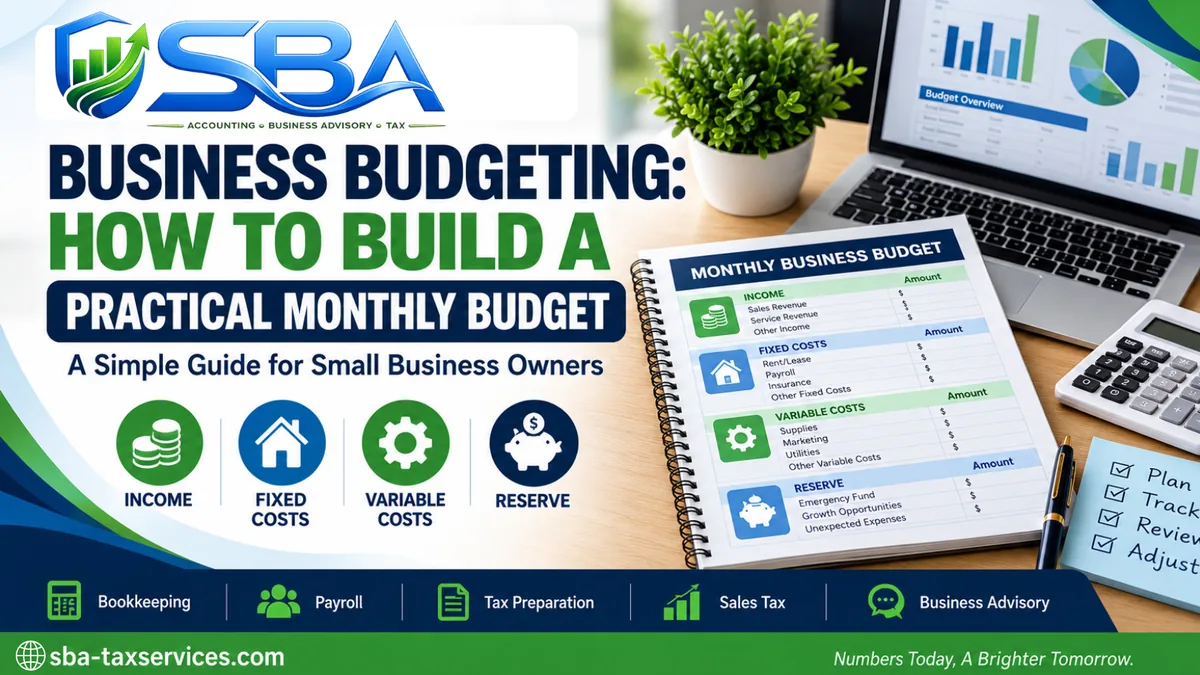
Creating a small business monthly budget gives you a structured way to plan income, organize expenses, and review how actual results compare with what you expected. However, a budget does not need to be complicated. If you are new to budgeting, start with your recent financial numbers and build from there. For many small businesses, a useful starting point is to organize expected income, fixed costs, variable costs, and a reserve for items that may change from month to month.
In addition, a practical monthly budget works best when it is connected to your cash-flow planning and bookkeeping records. The IRS notes that good records help business owners monitor business progress, prepare financial statements, identify income sources, track expenses, and support information reported on tax returns. IRS recordkeeping guidance.
What Is a Small Business Monthly Budget?
A small business monthly budget is a planning document that estimates the income and expenses you expect for a particular month. You can then compare those expectations with your actual results.
A simple budget can answer questions such as:
- How much revenue do I expect this month?
- Which expenses are fixed and which may change?
- How much do I need to set aside for upcoming costs?
- Where are actual expenses different from the plan?
- What should I review before the next month begins?
The purpose is not to predict every transaction perfectly. Instead, the budget gives you a practical framework for planning and reviewing your business finances.
- Why a monthly budget matters
- How to build a practical budget
- Fixed and variable costs
- Cash reserves and irregular expenses
- Budget-versus-actual reviews
- Common budgeting mistakes and questions
Why a Small Business Monthly Budget Matters
Business owners often look at revenue and account balances, but those numbers do not provide the full picture. Therefore, a monthly budget adds a forward-looking planning layer to your financial records.
When you compare your budget with actual results, you can identify differences that deserve attention. For example, revenue may be below your expectation, a recurring expense may have increased, or a variable cost may be higher than planned.
Furthermore, good bookkeeping supports this process because accurate records make it easier to compare the budget with actual income and expenses. The IRS explains that a recordkeeping system should clearly show business income and expenses and may be maintained using paper or electronic records. IRS guidance on recording business transactions.
The Four Main Parts of a Small Business Monthly Budget
1. Expected Income
First, start with the revenue you reasonably expect to receive during the month. Depending on your business, this could include product sales, service revenue, recurring client work, or other ordinary business income.
Next, use your historical records, current contracts, scheduled work, seasonality, and other information that is relevant to your business. Avoid treating an uncertain sale as guaranteed income simply because you hope it will happen.
2. Fixed Costs
Fixed costs are expenses that generally remain stable or change less frequently. Examples can include rent, recurring software subscriptions, insurance premiums, or other regular commitments.
However, not every expense stays exactly the same each month, so review your actual records rather than assuming every recurring cost is identical.
3. Variable Costs
Variable costs can change with sales volume, production, usage, staffing, or other business activity. Examples may include supplies, shipping, payment-processing costs, contract labor, or other costs that fluctuate with operations.
As a result, separating variable costs from more predictable expenses can make your monthly budget easier to review.
4. Reserve
A reserve is an amount you plan to keep available for expenses or changes that are not fully captured by your regular monthly categories. The appropriate amount depends on your business, cash position, obligations, and financial circumstances.
Importantly, the reserve category should not be treated as a substitute for understanding your actual expenses. It is a planning tool that can help you account for uncertainty.
Keep the process practical: start with realistic income, separate fixed and variable costs, account for irregular expenses and reserves, and compare actual results with the budget regularly.
How to Build a Small Business Monthly Budget Step by Step
Step 1: Review Previous Financial Results
First, begin with your recent bookkeeping and financial records. Look at revenue and major expense categories for prior months. This gives you a factual starting point instead of building the budget entirely from guesswork.
If your records are incomplete or inconsistent, improving the underlying bookkeeping should come before relying heavily on the budget. Otherwise, the budget may be based on incomplete information.
Step 2: Estimate Monthly Income
Next, list the revenue you expect for the upcoming month. Consider recurring customers, confirmed work, seasonal patterns, and other reasonably supportable information.
If your revenue varies significantly, consider preparing a conservative scenario and a higher-activity scenario rather than relying on one number.
Step 3: List Fixed Monthly Expenses
Then, create a list of recurring expenses and enter the amounts you expect to pay. Include the categories that apply to your business, such as rent, software, insurance, professional services, utilities, or recurring subscriptions.
The U.S. Small Business Administration recommends identifying expenses that are unique to your business and organizing costs to develop a clearer picture of financial requirements. U.S. Small Business Administration business-planning guidance.
Step 4: Estimate Variable Expenses
Afterward, review your historical spending and expected activity. If a cost usually rises when sales increase, make sure the budget reflects that relationship.
Do not automatically copy last month’s variable expenses. Instead, consider what is changing in the upcoming month.
Step 5: Add a Reserve Category
After listing expected income and expenses, determine whether you need a separate reserve category for uncertain or less frequent costs. The reserve should be based on your business circumstances rather than an arbitrary percentage presented as a universal rule.
Step 6: Compare Expected Income and Planned Costs
Once the categories are complete, compare expected income with planned expenses. This gives you a preliminary view of the month before it begins.
One simple planning calculation is:
Expected remaining amount = Expected income − Planned expenses
However, this is a budgeting calculation, not a guarantee of cash available. Timing differences between when income is earned, invoiced, received, and when expenses are paid can affect actual cash flow.
Step 7: Review the Budget During the Month
A budget is more useful when it is reviewed rather than created once and forgotten. Therefore, update actual results as transactions occur and compare them with the original plan.
For example, you might review the budget weekly and complete a more detailed month-end comparison after the books are updated.
Small Business Monthly Budget Example
Consider a hypothetical service business preparing a monthly budget:
| Category | Budgeted Amount |
|---|---|
| Expected Revenue | $20,000 |
| Fixed Costs | $6,000 |
| Variable Costs | $5,000 |
| Planned Reserve | $2,000 |
| Planned Remaining Amount | $7,000 |
This example is for illustration only. A real budget should reflect the business’s own revenue patterns, expenses, obligations, and cash timing.
Small Business Budget vs. Actual: What to Review
One of the most useful parts of monthly budgeting is the budget-versus-actual review. Instead, review individual categories rather than asking only whether the business stayed within a total spending limit.
For example:
- Was revenue close to the amount expected?
- Which expenses were higher or lower than planned?
- Were any unexpected costs recorded?
- Did a recurring expense change?
- Were there timing differences between expected and actual payments?
Ultimately, the goal is not to make every actual number match the budget. The goal is to understand meaningful differences and use that information when preparing the next budget.
Small Business Budgeting Mistakes to Avoid
Using Unrealistic Revenue Estimates
A budget becomes less useful when expected revenue is based primarily on optimism rather than information you can reasonably support.
Ignoring Small Recurring Expenses
In addition, software subscriptions, bank charges, supplies, service fees, and other smaller costs can accumulate. Review your bookkeeping records so recurring categories are not overlooked.
Mixing Personal and Business Spending
Similarly, keep business and personal transactions properly separated in your records. IRS guidance emphasizes maintaining records that clearly identify business income and expenses and supporting those entries with appropriate documentation. IRS guidance on business records.
Creating a Budget Without Reviewing Actual Results
A budget is a planning tool. Therefore, if you never compare it with actual results, you lose an important opportunity to learn from your financial records.
Treating the Budget as a Tax Return
A business budget is not a substitute for tax accounting or tax preparation. Tax treatment can depend on your business structure, accounting method, transaction type, and other facts. For federal tax rules, the IRS provides specific guidance on business income, expenses, accounting methods, and recordkeeping. IRS Publication 334.
How Bookkeeping Supports a Small Business Monthly Budget
Accurate bookkeeping gives you the historical information needed to build and review a practical budget. In turn, if you need help maintaining those records, see SBA’s bookkeeping services. Your books can help you identify income, categorize expenses, reconcile accounts, and prepare financial reports.
The IRS states that business records help owners monitor business progress and prepare financial statements, including income statements and balance sheets. IRS Publication 583.
For a small business, the budgeting process can therefore work as a cycle:
Record transactions → Review actual results → Build the next budget → Compare budget vs. actual → Adjust future planning.
Small Business Monthly Budget Review Checklist
- Review the previous month’s actual revenue.
- Review fixed and recurring expenses.
- Review variable expenses.
- Identify unusual or one-time transactions.
- Update expected income for the upcoming month.
- Update expected expenses.
- Review the planned reserve.
- Compare the new budget with recent financial results.
- Document important differences between budget and actual results.
- Update the budget when reliable new information changes the plan.
Small Business Monthly Budget FAQs
How detailed should a small business monthly budget be?
It should be detailed enough to help you understand meaningful income and expense categories without becoming so complicated that you stop maintaining it. The right level of detail depends on your business.
Should I update my business budget every month?
A monthly review is a practical approach for many small businesses. You can compare the previous month’s actual results with the budget and use the information to prepare the next month’s plan.
What expenses should I include in a monthly business budget?
For example, include the expenses relevant to your business, such as recurring operating costs, variable costs, payroll or contract labor where applicable, supplies, software, utilities, professional services, and other expected obligations. The SBA provides examples of expense categories businesses may need to consider, while the IRS provides guidance on business expenses and recordkeeping for federal tax purposes. SBA planning guidance and IRS Publication 334.
Is a monthly budget the same as a cash flow forecast?
Not necessarily. Instead, a budget is a planning framework for expected income and expenses. A cash flow forecast focuses more specifically on expected cash receipts and cash payments and their timing. The two tools can complement each other.
Final Thoughts on Small Business Monthly Budgeting
Overall, building a small business monthly budget does not have to be complicated. Start with reliable financial records, organize expected income and expenses, separate fixed and variable costs, and include a practical reserve category when appropriate.
Then, compare your budget with actual results. Over time, those comparisons can therefore help you understand your business finances and improve the assumptions used in future budgets.
If your bookkeeping records are not organized enough to support that process, improving the underlying records is a useful place to start.
SBA Accounting and Tax Services PLLC