
How to Read a Profit and Loss Statement
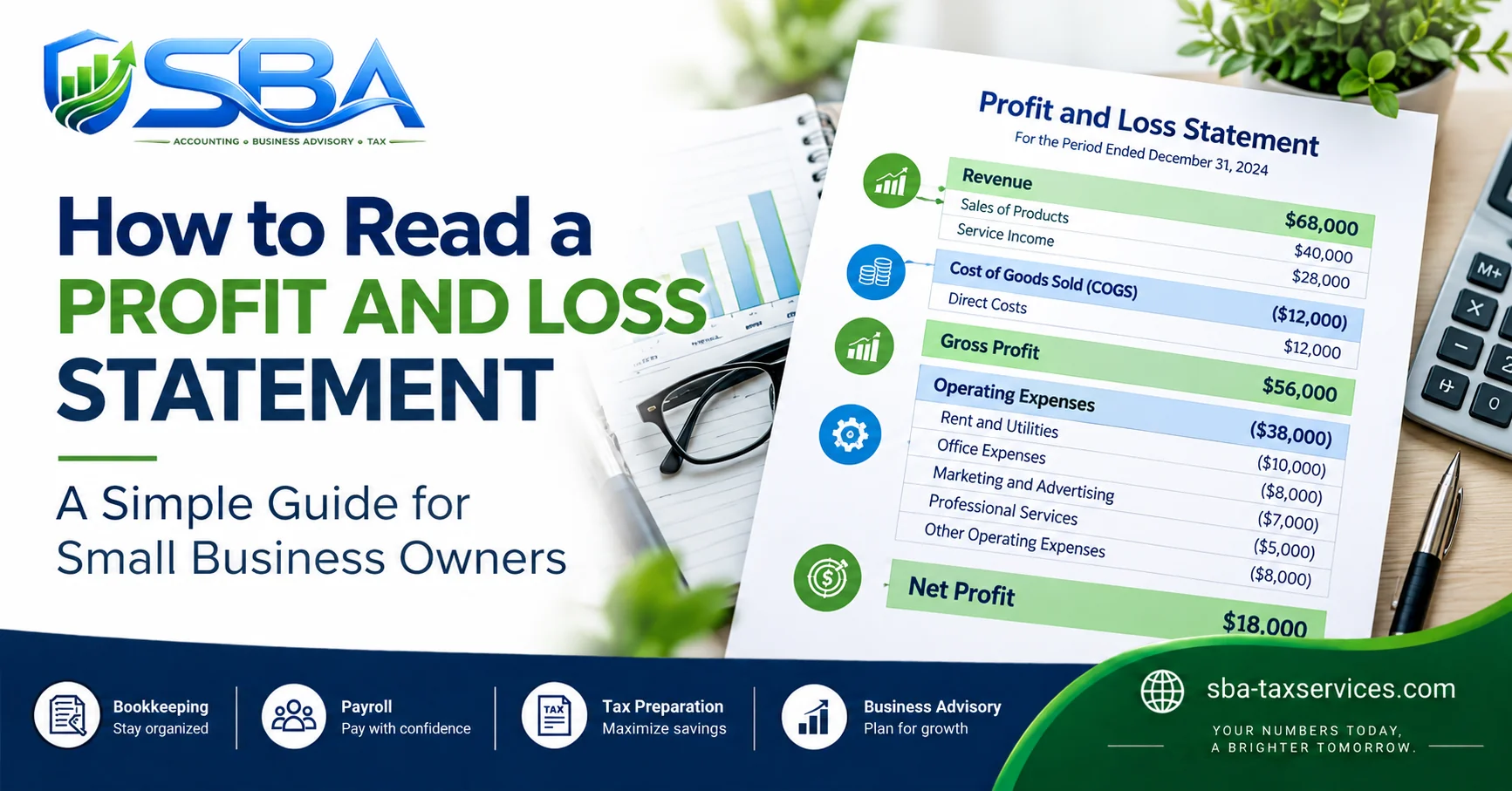
Learning how to read a profit and loss statement can help small business owners understand how their business is performing. Sales alone do not tell you whether your business is earning a profit. You also need to understand your expenses and how much money remains after those costs are accounted for.
Running a small business means making financial decisions every day. However, sales alone do not tell you whether your business is earning a profit. You also need to understand your expenses and how much money remains after those costs are accounted for.
A profit and loss statement, often called a P&L or income statement, helps you see this information in one report. It summarizes revenue, expenses, and the resulting profit or loss over a specific period.
If you have ever looked at a P&L and wondered what the financial numbers actually mean, this guide will help. You’ll learn how to read the main sections, follow the calculations, and use the information to ask better questions about your business.
- What a P&L statement shows
- The main sections and calculations
- A simple P&L example
- A six-step review process
- Common mistakes and questions to ask
- How bookkeeping supports useful reporting
Understanding How to Read a Profit and Loss Statement
A profit and loss statement shows a business’s income and expenses over a defined period, such as a month, quarter, or year. It helps explain whether the business reported a profit or a loss during that time.
For example, a monthly P&L can help you review how your business performed in August. Meanwhile, comparing several months can reveal changes in revenue, costs, and profitability.
A P&L is useful because it organizes financial activity into categories. Instead of looking at a long list of transactions, you can follow how revenue is reduced by costs and expenses to arrive at the reported result.
Keep in mind: A profit and loss statement does not show your entire financial position or necessarily tell you how much cash is currently in your bank account. It is one important financial report, and it should be considered alongside other records and reports.
Focus on the flow: start with revenue, review direct costs and gross profit, examine operating expenses, and then evaluate net profit or loss. Comparing these figures across periods gives the numbers useful context.
Main Sections: How to Read a Profit and Loss Statement
When you learn how to read a profit and loss statement, it helps to understand the main sections first. Most P&L statements include several key sections. The exact layout and account names can vary depending on the business and its accounting system. Nevertheless, the basic flow is generally similar.
1. Revenue: What Your Business Earned
Revenue is the income a business earns from selling products or providing services during the reporting period.
For example, a consulting business that provides services to clients may report those service fees as revenue. Similarly, a retailer may report sales of merchandise.
When reviewing revenue, consider the following questions:
- How much revenue did the business report for the period?
- Did revenue increase or decrease compared with the previous period?
- Which products, services, or customer groups contributed to the total?
- Were there unusual changes that need further investigation?
However, higher revenue does not automatically mean higher profit. Your costs and expenses also affect the final result.
2. Cost of Goods Sold: Direct Costs of Sales
Cost of goods sold, commonly abbreviated as COGS, generally represents the direct costs associated with the products sold or services provided. The specific costs included depend on the business and its accounting practices.
For example, a product-based business may include the cost of inventory sold. A service business may have direct labor or other costs associated with delivering its services, depending on how its accounts are organized.
Reviewing COGS helps you understand how much of your revenue is used to cover direct costs.
If revenue rises but direct costs rise even faster, the business may generate less gross profit than expected. Therefore, it is useful to review these figures together rather than examining revenue on its own.
3. Gross Profit: What Remains After Direct Costs
Gross profit is the amount left after subtracting cost of goods sold from revenue.
Formula:
Gross Profit = Revenue − Cost of Goods Sold
Example:
- Revenue: $40,000
- COGS: $15,000
- Gross profit: $25,000
This means $25,000 remains after the direct costs included in COGS are deducted. The business still needs to account for its other expenses.
Gross profit can help you examine pricing, direct costs, and the profitability of the products or services you sell. In addition, comparing gross profit across periods may help you identify changes that deserve a closer look.
4. Operating Expenses: The Costs of Running the Business
Operating expenses are costs associated with running the business that are not included in its cost of goods sold. Depending on the business, these may include:
- Rent and utilities
- Office expenses
- Software subscriptions
- Insurance
- Advertising and marketing
- Certain payroll and administrative costs
The categories shown on your P&L will depend on how your accounts are set up.
When reviewing operating expenses, compare the current period with previous periods. For instance, a sudden increase in software costs or advertising expenses may be worth investigating.
At the same time, do not assume that every increase is a problem. Some expenses may rise because the business is growing or investing in its operations. The important step is to understand what changed and why.
5. Understanding Net Profit When Reading a Profit and Loss Statement
Net profit is the amount remaining after the expenses included in the P&L have been deducted from revenue. If expenses exceed revenue, the statement will generally show a net loss.
A simplified formula is:
Net Profit = Revenue − Expenses
The exact calculation depends on the statement’s categories and accounting treatment. For example, a report may include other income, interest, taxes, depreciation, or additional adjustments.
Net profit helps you understand the result reported for the period. However, it should not be confused with the amount of cash available in your bank account.
A business can report a profit and still experience cash-flow pressure. This can happen, for example, when customers have not yet paid their invoices or when the business has significant payments due.
How to Read a Profit and Loss Statement Example
| Profit and Loss Item | Amount |
|---|---|
| Revenue | $40,000 |
| Cost of goods sold | $15,000 |
| Gross profit | $25,000 |
| Operating and other expenses | $18,000 |
| Net profit | $7,000 |
Revenue of $40,000 minus $15,000 in direct costs results in $25,000 of gross profit. After $18,000 in operating and other expenses, the reported net profit is $7,000.
This is an educational example. Actual P&L statements may include additional sections and may treat certain items differently.
How to Read a Profit and Loss Statement Step by Step
Step 1: Check the Reporting Period
Confirm the dates covered by the statement. Determine whether you are reviewing a monthly, quarterly, or year-to-date report. Compare appropriate periods so that the numbers provide useful context.
Step 2: Review Revenue
Examine total revenue and compare it with the previous period or budget. Investigate significant changes, such as changes caused by a major customer, seasonality, or lower-than-expected sales.
Step 3: Examine Direct Costs and Gross Profit
Review COGS and gross profit together. Investigate higher costs, pricing changes, or changes in the mix of products or services.
Step 4: Review Operating Expenses
Review expense categories for unusual increases, unexpected charges, or recurring costs. Consider the business context because planned investments can also increase expenses.
Step 5: Look at Net Profit or Net Loss
Review the reported result and compare it with earlier periods. Remember that one month may not represent the business’s overall financial performance.
Step 6: Follow Up on Unusual Numbers
Investigate underlying transactions, invoices, receipts, and account classifications. Confirm that the reporting period and transactions are recorded appropriately.
Common Mistakes When Reading a Profit and Loss Statement
Confusing Revenue With Profit
Revenue is income before expenses. Profit is what remains after relevant costs and expenses are deducted.
Assuming Net Profit Equals Cash in the Bank
A P&L shows financial performance for a period. Cash availability can differ, for example, because of unpaid invoices or bills that are due.
Reviewing Only One Month
One month may include seasonality or unusual events. Compare multiple periods when possible.
Ignoring How Transactions Are Categorized
Incorrect or inconsistent categorization can affect the P&L. Review underlying transactions when a number does not appear reasonable.
Making Decisions Without Context
A financial report is a starting point. Consider the business model, timing, budget, and other financial reports when reviewing results.
Questions to Ask When Reviewing Your Profit and Loss Statement
- Did revenue change compared with the previous period?
- What caused significant changes in direct costs?
- Is gross profit moving as expected?
- Which operating expense categories changed most?
- Did the business report a profit or loss?
- Are unusual transactions or adjustments affecting the results?
- Do I need to compare the P&L with cash flow information?
- Is there anything I should review with my bookkeeper or accountant?
How Bookkeeping Helps Keep Your P&L Useful
When you know how to read a profit and loss statement, accurate underlying financial records become even more useful. A P&L is only as useful as the underlying financial records. Missing or misclassified transactions can reduce clarity. Regular bookkeeping helps organize income and expenses, maintain records, and prepare information for review. For additional guidance on financial statements and recordkeeping, see IRS Publication 583.
Periodic account reviews can help identify discrepancies. Making financial reporting a regular routine rather than a year-end-only task can also provide better visibility into business performance. The U.S. Small Business Administration also provides guidance to help you manage your business finances.
Understand Your Numbers With SBA Accounting and Tax Services PLLC
Knowing how to read a profit and loss statement helps you ask informed questions. Reviewing revenue, direct costs, operating expenses, and net profit together gives you a clearer view of reported results.. Reviewing revenue, direct costs, operating expenses, and net profit together gives you a clearer view of reported results.
SBA Accounting and Tax Services PLLC provides bookkeeping services, accounting, tax preparation, payroll, sales tax, and business advisory services.
If you need help organizing your records or understanding your financial reports, contact SBA Accounting and Tax Services PLLC.
Frequently Asked Questions
What does a profit and loss statement tell you?
A profit and loss statement summarizes revenue and expenses over a period and shows the resulting profit or loss.
How often should a small business review its P&L?
Many businesses review their P&L monthly. The appropriate frequency depends on the business’s activities and financial management needs.
What is the difference between gross profit and net profit?
Gross profit is generally revenue minus cost of goods sold. Net profit is the amount remaining after expenses, subject to the accounting treatment used in the statement.
Can a business be profitable but still have cash-flow problems?
Yes. Profit and cash flow measure different aspects of a business. Unpaid invoices and bills that are due can affect available cash even when a business reports a profit.
Is a profit and loss statement the same as a balance sheet?
No. A P&L summarizes income and expenses over a period. A balance sheet reports assets, liabilities, and equity at a specific point in time.




5 Responses