
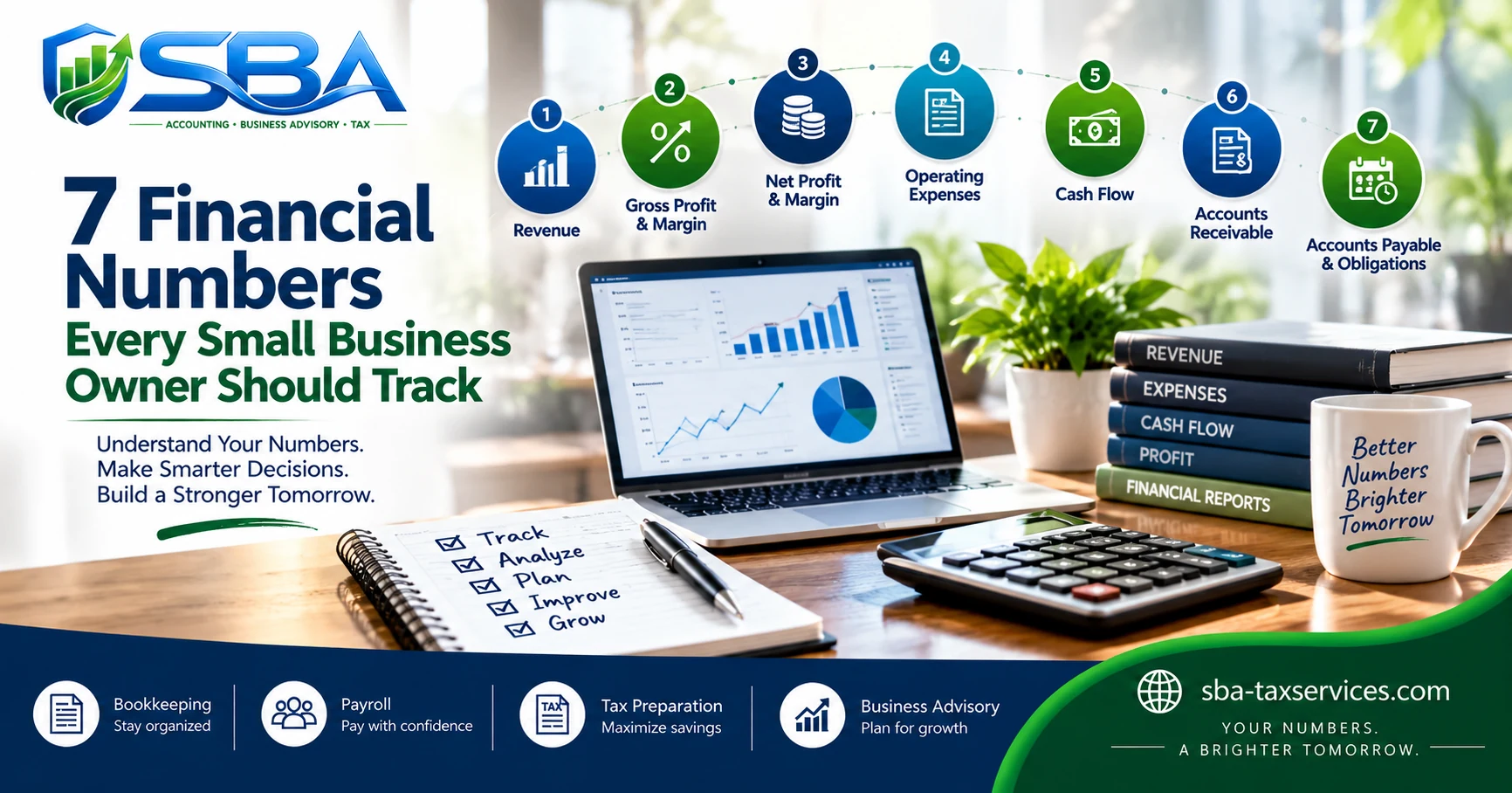
Running a small business involves more than making sales. In addition, you need to understand what those sales are producing, where your money is going, and whether your business has the resources to meet its obligations.
Fortunately, you do not need to be an accountant to begin understanding your finances. A handful of regularly reviewed financial metrics can help you recognize trends, ask better questions, and make more informed business decisions.
- Revenue
- Gross profit and gross profit margin
- Net profit and net profit margin
- Operating expenses
- Cash flow
- Accounts receivable and overdue invoices
- Accounts payable and upcoming obligations
Here are seven important numbers to include in your financial review.
1. Revenue
Revenue is the income your business earns from selling products or providing services before expenses are deducted. In other words, it measures sales before accounting for costs.
Tracking revenue helps you understand how much business you are generating and whether sales are changing over time. For example, comparing monthly figures can reveal patterns in your sales.
Review your revenue:
- Monthly and quarterly
- Where useful, compare revenue with the same period last year.
- You can also review revenue by product, service, or customer segment when your records allow it.
A revenue increase can be encouraging, but it does not automatically mean your business is more profitable. That is because expenses and the timing of customer payments also matter.
2. Gross Profit and Gross Profit Margin
Specifically, gross profit shows what remains from revenue after subtracting the direct costs associated with the products or services sold.
Formula:
Gross Profit = Revenue − Cost of Goods Sold
Gross profit margin expresses that amount as a percentage of revenue.
Formula:
Gross Profit Margin = (Gross Profit ÷ Revenue) × 100
For instance, if a business earns $50,000 in revenue and has $20,000 in direct costs:
- Gross profit: $30,000
- Gross profit margin: 60%
By monitoring gross profit margin, you can examine pricing, direct costs, and changes in the mix of products or services you sell. The appropriate margin varies by industry and business model. Therefore, compare your results with your own history and relevant industry context.
3. Net Profit and Net Profit Margin
Net profit reflects what remains after the expenses included in your income statement have been deducted from revenue.
Formula:
Net Profit = Revenue − Expenses
Net profit margin shows the percentage of revenue remaining as net profit.
Formula:
Net Profit Margin = (Net Profit ÷ Revenue) × 100
For instance, if revenue is $50,000 and total expenses are $45,000, net profit is $5,000 and net profit margin is 10%.
By reviewing net profit over time, you can understand whether revenue is translating into earnings after expenses. When reviewing this figure, make sure you understand which expenses and accounting adjustments are included in the calculation.
4. Operating Expenses
Operating expenses are the ongoing costs of running your business, such as rent, utilities, software, insurance, and many payroll costs. For example, these costs may continue even when sales fluctuate.
By tracking these expenses, you can identify changes and understand how much it costs to operate.
You can review:
- Total operating expenses
- Individual expense categories
- Changes from month to month
- Operating expenses as a percentage of revenue
Formula:
Operating Expense Ratio = (Operating Expenses ÷ Revenue) × 100
If expenses rise faster than revenue, it may be useful to investigate what changed. However, an increase is not necessarily a problem. For instance, additional staffing may support planned growth, but the reason for the increase should still be understood.
5. Cash Flow
Cash flow measures money moving into and out of your business during a period. Unlike profit, it reflects the movement of money. A business can record revenue before receiving payment. Additionally, it may pay for equipment or other items that do not appear as an immediate expense in the same way.
To understand your cash position, monitor:
- Cash received from customers
- Payments for operating costs
- Upcoming payroll and tax obligations
- Major purchases and debt payments
- Your projected cash position
As a result, a cash-flow forecast can help you anticipate periods when expected payments may exceed available funds. The U.S. Small Business Administration includes bookkeeping, financial records, and cash-flow planning among its business-finance resources.
6. Accounts Receivable and Overdue Invoices
Accounts receivable represents amounts customers owe your business for goods or services already provided, where payment has not yet been collected.
For a clearer picture of outstanding customer payments, review:
- How much customers currently owe
- Which invoices are overdue
- How long invoices have remained unpaid
- Also consider whether particular customers account for a large share of outstanding balances.
An accounts receivable aging report groups unpaid invoices by how long they have been outstanding. Reviewing it regularly can help you prioritize follow-ups and investigate collection delays.
Importantly, recorded revenue and collected cash are not always the same thing, particularly when using accrual accounting.
7. Accounts Payable and Upcoming Obligations
Meanwhile, accounts payable generally represents amounts your business owes suppliers and vendors for goods or services received but not yet paid for.
To stay aware of upcoming obligations, track:
- Outstanding supplier bills
- Invoice due dates
- Upcoming payroll and tax payments
- Loan payments and other scheduled obligations
- Finally, consider whether payment timing aligns with expected cash receipts.
Keeping these obligations organized can help you plan cash requirements and reduce the risk of overlooking due dates.
Your accounts payable records should be reviewed alongside receivables and your cash-flow forecast—not in isolation.
How Often Should You Review These Numbers?
A useful starting routine is:
| Frequency | What to review |
|---|---|
| Weekly | Cash position, upcoming payments, overdue customer invoices |
| Monthly | Revenue, gross profit, net profit, operating expenses, and cash flow |
| Quarterly | Longer-term trends, margins, major cost changes, and financial plans |
The appropriate schedule depends on your business’s size, activity, seasonality, and financial complexity. The key is to use consistent records and compare results across meaningful periods.
Turn Financial Numbers Into Useful Questions
Numbers become more useful when you investigate what is behind them. To do this, ask the following questions during your review:
- Is revenue changing—and what is contributing to that change?
- For example, ask: Are direct costs increasing faster than sales?
- What caused a change in profit margin?
- Are operating expenses consistent with the business’s plans?
- Will expected cash receipts cover upcoming obligations?
- Are customers paying within the expected timeframe?
- Are supplier bills and other obligations being tracked accurately?
These questions can help you identify areas that deserve further review. However, they do not replace professional accounting or tax advice when a decision requires it.
Keep Your Financial Records Organized
Ultimately, reliable financial metrics depend on accurate, up-to-date records. Regular bookkeeping, bank reconciliations, and consistent categorization help make reports more useful.
The SBA recommends maintaining proper bookkeeping and understanding basic business financial information. In addition, its resources explain how a balance sheet can help track assets, liabilities, and equity.
Need Help Organizing Your Business Finances?
SBA Accounting and Tax Services PLLC offers bookkeeping, payroll, tax preparation, sales tax, and business advisory services to help small businesses maintain organized financial records and better understand their numbers.
Visit our website to learn more about our services or contact our team.
Numbers Today, A Brighter Tomorrow.






4 Responses