
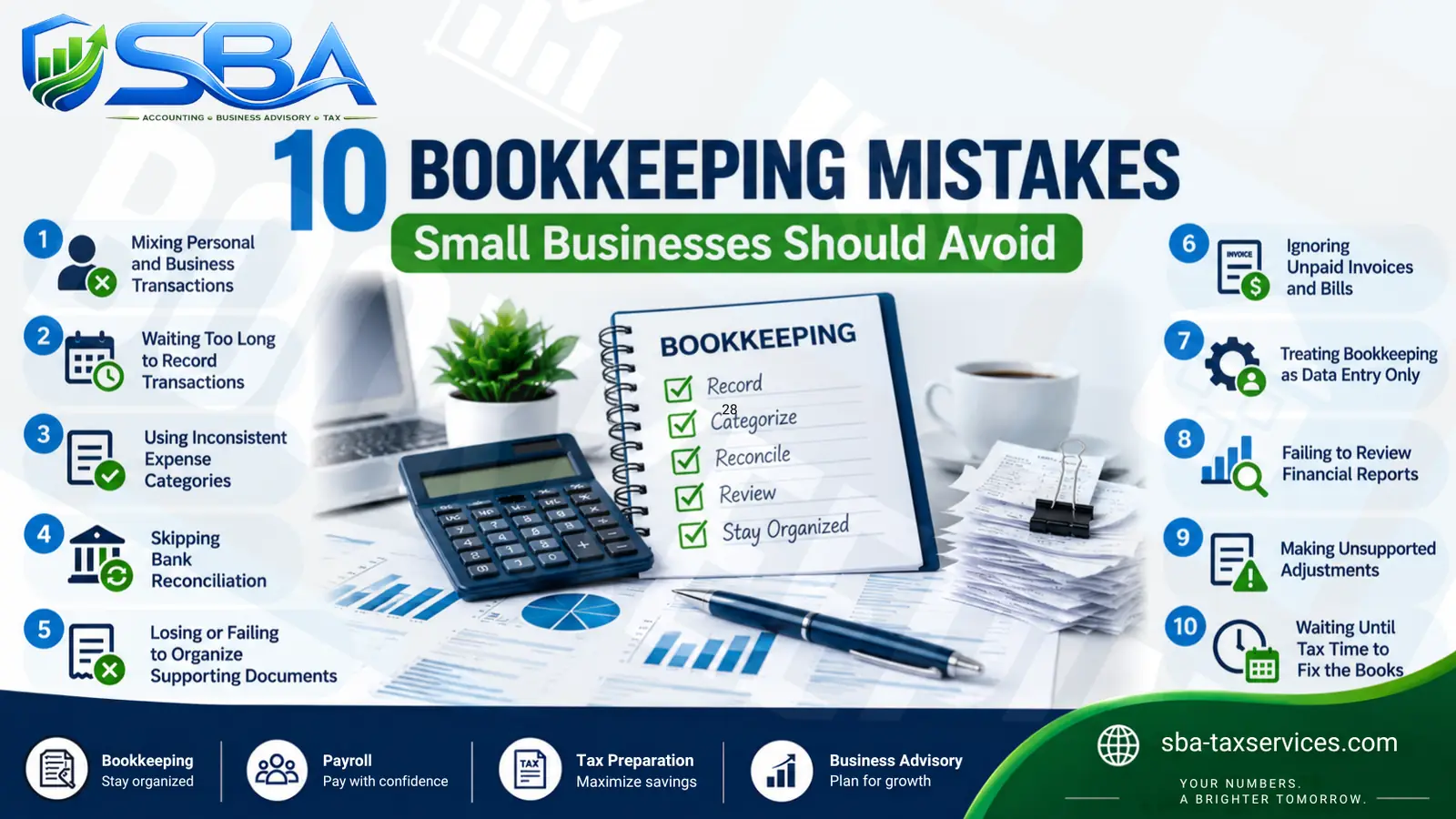
Bookkeeping mistakes can make otherwise useful financial records harder to understand and harder to rely on. Small-business owners often make these errors because transactions are recorded late, personal and business spending gets mixed together, or financial information is not reviewed regularly.
The good news is that many bookkeeping problems are preventable. Therefore, a simple review process can help you catch issues before they become larger problems.
In this guide, we will look at 10 common bookkeeping mistakes, explain why they matter, and outline practical habits that can make your records more consistent.
02 Falling behind on transaction entry
03 Using inconsistent expense categories
04 Skipping bank reconciliation
05 Losing supporting documents
06 Ignoring unpaid invoices and bills
07 Treating bookkeeping as data entry only
08 Failing to review financial reports
09 Making unsupported adjustments
10 Waiting until tax time to fix the books
1. Bookkeeping Mistakes: Mixing Personal and Business Transactions
One of the most common bookkeeping mistakes is using business accounts for personal spending without properly identifying the transaction.
When you mix personal and business transactions, the bookkeeping records become harder to interpret. In addition, it can make it more difficult to determine which transactions belong to the business.
The IRS explains that businesses should maintain records that clearly show business income and expenses.
A Better Habit for Avoiding Bookkeeping Mistakes
Use separate business banking and payment accounts where appropriate. Then, when a transaction does have a personal component, identify and handle it correctly instead of leaving it buried among ordinary business expenses.
Simple check: Review your bank and credit-card activity and ask, “Can I explain why every business transaction belongs in the books?”
2. Bookkeeping Errors: Waiting Too Long to Record Transactions
Another bookkeeping mistake is allowing transactions to accumulate for weeks or months.
The longer transactions remain unrecorded, the harder it can become to remember what a payment was for, locate the supporting document, or identify an error.
The IRS notes that recording transactions on a daily basis is generally a good recordkeeping practice.
A Better Habit for Avoiding Bookkeeping Mistakes
Create a regular bookkeeping routine. For example, record new income and expenses, attach or organize supporting documents, review uncategorized transactions, check unusual items, and keep the bookkeeping system current.
The exact frequency can vary by business, but consistency matters more than waiting for a convenient time.
3. Bookkeeping Errors: Using Inconsistent Expense Categories
Bookkeeping mistakes can also happen when similar transactions are repeatedly categorized in different ways, making the bookkeeping system less useful.
For example, one software subscription might be recorded under software expenses while another is recorded under office expenses. As a result, the totals may become less meaningful when you review your financial reports.
A Better Habit for Avoiding Bookkeeping Mistakes
Create a practical chart of accounts and use consistent categories. The categories should reflect the nature of the business and its accounting system. They do not need to be unnecessarily complicated.
Before creating a new category, ask: “Do I actually need a separate category, or does an existing category already describe this transaction?”
4. Bookkeeping Errors: Skipping Bank Reconciliation
Avoiding bookkeeping mistakes requires more than recording transactions; reconciliation is another essential part of bookkeeping.
You should also compare your bookkeeping records with statements from financial institutions and investigate differences. Accountants commonly call this process bank reconciliation.
For example, your books may show a different balance from your bank statement because of timing differences, outstanding transactions, fees, missing entries, or errors.
A Better Habit
Reconcile your accounts on a consistent schedule. During the review, compare bank statements, credit-card statements, deposits, withdrawals, electronic payments, outstanding transactions, and accounting-system entries.
Therefore, reconciliation should be treated as a quality-control step rather than simply another bookkeeping task.
5. Bookkeeping Mistakes: Losing or Failing to Organize Supporting Documents
A bookkeeping mistake involving missing supporting documentation can create questions later.
A Better Habit
Create a consistent document-management system. For example, you might organize records by year, month, vendor or customer, transaction type, account, and expense category.
Digital storage can make organization easier. However, the important issue is that records remain complete, accessible, and connected to the transactions they support.
6. Bookkeeping Errors: Ignoring Unpaid Invoices and Bills
Some bookkeeping mistakes happen when owners focus only on transactions that have already cleared the bank.
If customers owe the business money, you may need to monitor those amounts. Likewise, unpaid vendor bills can affect the business’s financial picture. In addition, review those bills as part of the same process.
When these items are ignored, the owner may have an incomplete understanding of what is coming in and what is owed.
A Better Habit
Review receivables and payables regularly. Ask which customers still owe money, which invoices are overdue, which bills are approaching their due dates, and whether there are unusual balances that need investigation.
This review can be especially useful when evaluating cash flow for a small business.
7. Bookkeeping Mistakes: Treating Bookkeeping as Data Entry Only
Another common bookkeeping mistake is assuming that bookkeeping is complete once numbers have been entered.
Good bookkeeping should produce information that can actually be reviewed and understood.
For example, if expenses are recorded but unusual increases are never investigated, the business is collecting information without fully using it.
A Better Habit
After recording transactions, periodically step back and review the bigger picture. Look for unusual expenses, revenue changes, repeated charges, missing transactions, significant category changes, and unexplained balances.
In other words, bookkeeping should support understanding, not just data storage.
8. Bookkeeping Mistakes: Failing to Review Financial Reports
One way to catch bookkeeping mistakes is to turn accurate records into financial reports and review them regularly.
Depending on the business and accounting system, reports may include an income statement or profit and loss statement, balance sheet, and cash-flow information. In addition, review the cash-flow information regularly.
These reports can reveal changes that are difficult to see by looking at individual transactions. For more context, see SBA’s guide to financial reports every small business owner should understand. If you use a profit and loss statement to review performance, you can also see SBA’s guide to how to read a profit and loss statement.
A Better Habit
Set a recurring financial-review appointment with yourself or your bookkeeping team. Then use the same review checklist each time.
| Review area | Question to ask |
|---|---|
| Revenue | What changed from the previous period? |
| Expenses | Which costs increased? |
| Cash | How much is currently available? |
| Receivables | What remains unpaid? |
| Payables | What needs to be paid? |
| Profitability | What does the current period show? |
Context matters. A single month’s number does not necessarily explain a long-term trend. Therefore, compare periods when appropriate.
9. Bookkeeping Errors: Making Unsupported Adjustments
When a bookkeeping mistake creates a difference, an owner may be tempted to “make the numbers work” with an unexplained adjustment.
That approach can create a new problem instead of solving the original one.
If a balance does not reconcile, determine why it differs.
A Better Habit
First, identify the difference. Next, trace the relevant transaction or transactions. Then, check the supporting documentation. Finally, make the appropriate correction and document what was changed.
This creates a clearer audit trail than entering unexplained adjustments.
10. Bookkeeping Mistakes: Waiting Until Tax Time to Fix the Books
One of the most avoidable bookkeeping mistakes is treating bookkeeping as a once-a-year activity.
Tax preparation depends on financial information. Therefore, waiting until tax time to discover missing transactions, uncategorized expenses, or unreconciled accounts can create unnecessary pressure.
The IRS explains that good records support tax preparation and the items reported on tax returns.
A Better Habit
Make bookkeeping a year-round process. A practical cycle can look like this:
Then repeat the process. This connects naturally with the broader bookkeeping workflow covered in SBA’s step-by-step small business bookkeeping guide.
1. Are all transactions recorded?
2. Are income and expenses categorized consistently?
3. Are business and personal transactions separated appropriately?
4. Have bank and credit-card accounts been reconciled?
5. Are supporting documents organized?
6. Are unpaid invoices and bills being monitored?
7. Have unusual transactions been investigated?
8. Have financial reports been reviewed?
9. Are corrections supported by documentation?
10. Is the bookkeeping current rather than waiting for tax season?
How to Prevent Bookkeeping Mistakes
The best way to reduce bookkeeping mistakes is to build a repeatable process rather than relying on memory.
Daily or Transaction-Level
Record new transactions and retain supporting documentation.
Weekly
Review uncategorized transactions, unusual activity, and outstanding items.
Monthly
Reconcile accounts and review financial reports.
Periodically
Review the bookkeeping system itself. Ask whether the categories, reports, and workflow still fit the business.
Therefore, the goal is not perfect bookkeeping through a complicated system. The goal is a reliable process that is used consistently. If expense organization is a recurring challenge, review SBA’s guide to tracking business expenses.
When Should You Get Bookkeeping Help?
A business may benefit from additional bookkeeping support when transaction volume increases, records consistently fall behind, reconciliations are not being completed, or the owner no longer has enough time to maintain the books properly.
Before seeking support, identify the specific problem. Is the challenge time, transaction volume, reconciliation, reporting, organization, software, or understanding the records?
Once the problem is clear, it becomes easier to determine what type of bookkeeping support may be appropriate.
Frequently Asked Questions
What are the most common bookkeeping mistakes?
Common problems include mixing personal and business transactions, recording transactions late, inconsistent categorization, skipping reconciliations, losing supporting documents, ignoring unpaid balances, failing to review reports, and waiting until tax time to address bookkeeping problems.
How often should a small business update its books?
There is no single schedule that fits every business. However, regular updating is generally easier to maintain than allowing transactions to accumulate for long periods. The IRS notes that recording transactions daily is generally a good recordkeeping practice.
Why is bank reconciliation important?
Reconciliation compares the accounting records with financial-account statements and helps identify differences, missing transactions, timing issues, and possible errors.
Should business and personal expenses be separated?
Businesses should maintain records that clearly show business income and expenses. Keeping business and personal activity appropriately separated can make recordkeeping easier and clearer. See IRS recordkeeping guidance.
Can bookkeeping software prevent mistakes?
Software can help organize transactions and records, but it does not eliminate the need for review. The IRS notes that electronic systems are subject to the same basic recordkeeping principles as paper records.
Conclusion
Bookkeeping mistakes are often easier to prevent than to repair.
A consistent process can help a small business keep its financial records organized and useful. Record transactions promptly, categorize them consistently, reconcile accounts, retain supporting documents, and review the resulting financial information.
Ultimately, reliable bookkeeping is not just about entering numbers. It is about creating financial information you can understand, review, and use.
SBA Accounting and Tax Services PLLC provides bookkeeping and accounting support designed to help small businesses maintain organized financial records and better understand their numbers.
Numbers Today, A Brighter Tomorrow.