
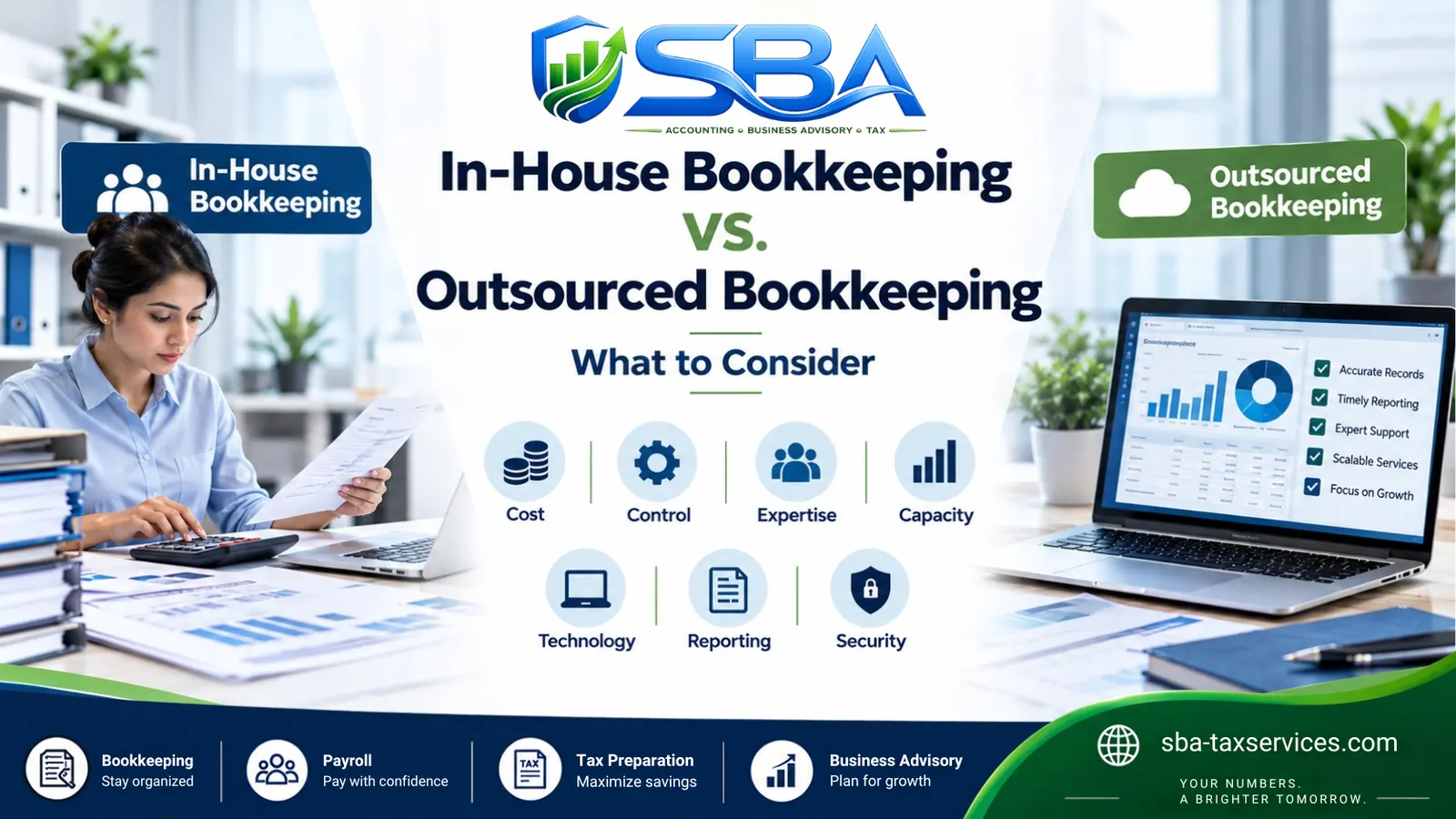
Bookkeeping is an essential part of running a small business, but outsourced vs in house bookkeeping is not a one-size-fits-all decision.
Some businesses prefer to keep bookkeeping responsibilities inside the company. Others use an outside bookkeeper or accounting service. In some cases, a business may use a combination of internal staff and outside support.
The right arrangement can depend on your transaction volume, internal capacity, reporting needs, budget, systems, and the level of oversight you want.
Fortunately, you do not have to make the decision based on a simple “in-house versus outsourced” rule. Instead, you can compare the responsibilities, costs, workflow, expertise, technology, and business needs involved in each approach.
This guide explains the main considerations so you can evaluate which bookkeeping arrangement fits your business.
Key Takeaway
There is no universal winner between in-house and outsourced bookkeeping.
Instead, consider:
- Cost and available budget
- Amount of bookkeeping work
- Internal staff capacity
- Bookkeeping expertise
- Oversight and communication
- Technology and workflow
- Reporting requirements
- Security and access
- Business continuity
- Future growth
The goal is to build a bookkeeping process that produces reliable financial information without creating unnecessary administrative pressure.
In This Guide
- In-house bookkeeping
- Outsourced bookkeeping
- Cost considerations
- Expertise and capacity
- Control and oversight
- Technology and workflow
- Security and access
- Reporting needs
- Owner time
- Questions to ask before choosing an approach
- When to reconsider your current setup
What Is In-House Bookkeeping?
In-house bookkeeping means bookkeeping responsibilities are handled by someone within the business.
That person could be:
- The business owner
- An administrative employee
- An office manager
- A dedicated bookkeeper
- An accounting employee
- Another member of the internal team
The exact arrangement can vary significantly from one business to another.
For example, a small company might have an office manager enter transactions and reconcile the bank account. A larger business might employ a dedicated bookkeeping or accounting team.
Potential Advantages of In-House Bookkeeping
Keeping bookkeeping inside the business can provide direct access to the person handling the records.
Depending on the setup, this may make it easier to:
- Ask questions quickly
- Coordinate bookkeeping with daily operations
- Maintain direct internal oversight
- Keep financial processes within the company
- Adjust workflows as business needs change
However, these benefits also depend on having enough internal capacity and appropriate bookkeeping knowledge.
What Is Outsourced Bookkeeping?
Outsourced bookkeeping means some or all bookkeeping responsibilities are performed by an external provider.
The provider may work remotely or through another arrangement, depending on the service.
Outsourced bookkeeping can cover different responsibilities, such as:
- Transaction categorization
- Bank reconciliation
- Accounts payable
- Accounts receivable
- Financial reporting
- Monthly bookkeeping
- Record organization
- Bookkeeping review
The exact scope should be defined before the relationship begins.
The SBA notes that businesses may obtain accounting help from a CPA, bookkeeper, or online service.
Potential Advantages of Outsourced Bookkeeping
Depending on the provider and engagement, outsourcing may give a business access to bookkeeping support without creating an internal bookkeeping position.
It may also allow business owners to delegate recurring bookkeeping responsibilities while retaining access to financial information and reports.
However, outsourcing does not remove the business owner’s responsibility to understand the company’s financial position or maintain appropriate oversight.
Outsourced vs In-House Bookkeeping: Side-by-Side Comparison
When comparing outsourced vs in house bookkeeping, start by looking at your business’s current needs rather than assuming one model is right for everyone.
| Consideration | In-House Bookkeeping | Outsourced Bookkeeping |
|---|---|---|
| Staffing | Requires internal capacity | Uses an external provider |
| Oversight | Direct internal supervision | Requires communication and review processes |
| Expertise | Depends on internal employee knowledge | May provide access to bookkeeping expertise |
| Cost structure | Often includes employee-related costs | Usually based on agreed service scope or pricing |
| Workflow | Integrated directly into company operations | Requires coordination with an outside provider |
| Technology | Business manages its systems | Provider may bring or work with existing systems |
| Availability | Depends on internal staffing | Depends on provider availability and agreement |
| Scalability | May require additional internal capacity | Scope can potentially change with business needs |
| Reporting | Internal team prepares or coordinates reports | Provider may prepare agreed reports |
| Continuity | Can be affected by employee turnover | Depends on provider continuity and documentation |
This table is a starting point rather than a universal formula. In practice, businesses can structure either model in different ways.
Outsourced vs In House Bookkeeping Cost: Look Beyond the Pay Rate
Cost is often one of the first questions businesses ask.
However, comparing only an employee’s wage with an outsourcing fee can produce an incomplete picture.
In-House Bookkeeping Costs Can Include:
- Wages or salary
- Payroll taxes and benefits
- Training
- Software
- Equipment
- Management time
- Recruiting
- Vacation or sick coverage
- Ongoing supervision
The actual cost depends on the employee arrangement and responsibilities.
Outsourced Bookkeeping Costs Can Include:
- Monthly service fees
- Additional services
- Cleanup work
- Special reporting
- Additional transactions
- Tax or accounting services outside the agreed scope
Therefore, compare the total cost of the bookkeeping function, not just the most visible price. For a related guide, see Business Expenses: What to Track and Why Accurate Records Matter.
When evaluating outsourced vs in house bookkeeping, include the full cost of the work and the capacity required to keep records current.
Outsourced vs In House Bookkeeping: How Much Work Does Your Business Have?
The amount of bookkeeping activity matters.
A business with relatively few transactions may have very different bookkeeping needs from a business processing hundreds or thousands of transactions.
Consider:
- Number of monthly transactions
- Number of bank accounts
- Credit-card activity
- Payroll
- Accounts receivable
- Accounts payable
- Inventory
- Multiple locations
- Multiple revenue streams
- Required financial reports
As transaction volume increases, bookkeeping can require more time and more structured processes.
For that reason, a setup that worked when a company was smaller may eventually need to change.
In-House vs Outsourced Bookkeeping: Expertise and Capacity
Bookkeeping requires more than entering numbers.
The person handling the books may need to understand the company’s accounting system, transaction categories, reconciliations, supporting documentation, and reporting requirements.
The IRS emphasizes that businesses need records that clearly show income and expenses and that supporting documents should support entries in the books.
Therefore, ask:
- Does the person handling the books understand the accounting system?
- Can they reconcile accounts?
- Can they identify unusual transactions?
- Can they maintain supporting documentation?
- Can they produce useful reports?
- Do they have enough time to keep the books current?
If the answer to several of these questions is no, the current structure may need review.
In-House vs Outsourced Bookkeeping: Control and Oversight
One common consideration is control.
With an internal employee, bookkeeping activities may be physically or operationally closer to management.
With an outside provider, however, a business can still maintain oversight through:
- Defined responsibilities
- User permissions
- Regular reporting
- Account reconciliation
- Scheduled reviews
- Documented procedures
- Regular communication
The key issue is not simply where the bookkeeper works.
Instead, consider how the bookkeeping process is controlled and reviewed.
Outsourced Bookkeeping and In-House Bookkeeping: Technology and Workflow
Modern bookkeeping often depends on accounting software and electronic records.
The IRS recognizes electronic accounting systems and explains that electronic records must provide a complete and accurate record that is accessible to the IRS when required.
Therefore, technology should be part of your comparison.
Ask:
- What accounting software do you use?
- Who has access?
- Who enters transactions?
- Who reconciles accounts?
- How are documents uploaded?
- How are reports generated?
- How are permissions managed?
- How are records backed up?
- What happens when a process changes?
A strong bookkeeping arrangement should fit the company’s actual workflow rather than forcing employees or owners into unnecessary manual processes.
In-House vs Outsourced Bookkeeping: Security and Access
Financial records contain sensitive business information.
Whether bookkeeping is handled internally or externally, access should be managed carefully.
Consider:
- User permissions
- Password security
- Access to bank accounts
- Accounting-system permissions
- Document storage
- Employee departures
- Provider access
- Backup procedures
For either model, determine who can access financial systems and what level of access each person actually needs.
Outsourced vs In House Bookkeeping: Reporting Needs
Bookkeeping is not only about recording transactions.
Good records can help a business prepare financial statements and understand its financial position. The IRS specifically notes that good records can help businesses prepare financial statements and monitor business progress.
Therefore, think about what information you actually need.
For example:
- Monthly profit and loss statement
- Balance sheet
- Cash-flow information
- Accounts receivable
- Accounts payable
- Expense tracking
- Budget comparisons
- Management reports
If the bookkeeping process produces records but does not provide the information management needs, the process may need improvement. See How to Read a Profit and Loss Statement for a related guide to understanding one of the key reports a business may review.
Outsourced vs In House Bookkeeping: How Much Owner Time Is Required?
For many small businesses, the owner’s time is an important consideration.
When owners handle bookkeeping themselves, the work may compete with:
- Sales
- Customer service
- Operations
- Hiring
- Business development
- Strategic planning
That does not mean owners should never handle their own books.
Instead, ask whether bookkeeping is still a practical use of the owner’s time.
If bookkeeping repeatedly gets postponed, reconciliations fall behind, or reports are unavailable when decisions need to be made, it may be time to review the current process.
Your Business Does Not Have to Choose Only One Model
The decision does not always have to be completely internal or completely external.
A business could use a hybrid arrangement.
Internal team
- Upload documents
- Handle daily administrative tasks
- Approve transactions
- Communicate operational details
External bookkeeping support
- Reconcile accounts
- Review transactions
- Maintain bookkeeping records
- Prepare agreed reports
- Provide bookkeeping guidance
This type of arrangement can allow the business to retain internal involvement while obtaining additional bookkeeping support.
The appropriate structure depends on the company’s needs and the responsibilities assigned to each party.
Outsourced vs In House Bookkeeping: Questions Before Keeping It In-House
- Who will be responsible for the books?
- Does that person have sufficient bookkeeping knowledge?
- How much time can they dedicate to bookkeeping?
- Who will review their work?
- Who handles reconciliations?
- Who prepares monthly reports?
- What happens when the employee is unavailable?
- What happens if transaction volume increases?
- Is the software appropriate for the business?
- Are financial records being maintained consistently?
If these questions do not have clear answers, the business may need a more defined bookkeeping process.
Outsourced vs In House Bookkeeping: Questions Before Outsourcing
- What services are included?
- What services cost extra?
- Who will actually perform the work?
- How often will the books be updated?
- Who handles bank reconciliation?
- What reports will be provided?
- How will documents be shared?
- How will access permissions be managed?
- How will questions be communicated?
- What happens if the business grows or its needs change?
Most importantly, make sure both sides understand the scope of work.
When Should You Reconsider Your Bookkeeping Setup?
Your bookkeeping arrangement may deserve another look when:
- Transaction volume increases
- The business adds employees
- You add bank or credit accounts
- Financial reports are consistently delayed
- Reconciliations fall behind
- The owner spends too much time on bookkeeping
- The business expands into new locations
- Accounting software becomes difficult to manage
- The current bookkeeper no longer has enough capacity
- Management needs more detailed reporting
A change in bookkeeping structure does not necessarily mean the previous approach was wrong.
Instead, it may simply mean that the business has changed.
Why Bank Reconciliation Matters in Either Model
Regardless of who handles the bookkeeping, bank reconciliation remains an important part of the process.
A reconciliation compares accounting records with the corresponding financial account activity and helps identify differences that need review.
The SBA specifically lists bank reconciliation among the financial functions businesses should ensure are managed.
For that reason, ask one simple question:
Who is responsible for making sure the accounts are reconciled and reviewed?
The answer should be clear whether bookkeeping is handled internally, externally, or through a combination of both.
For more detail, see our guide to Business Bank Reconciliation.
How to Compare Outsourced vs In House Bookkeeping
Instead of asking, “Which bookkeeping option is better?” ask:
“Which bookkeeping setup fits our current business needs?”
Review these categories:
1. Cost of In-House vs Outsourced Bookkeeping
What is the total cost of maintaining the bookkeeping function?
2. Bookkeeping Capacity
Does the person or provider have enough time to keep the books current?
3. Bookkeeping Expertise
Does the arrangement provide the bookkeeping knowledge the business needs?
4. Oversight
Can management review the work and obtain answers when necessary?
5. Reporting
Will the business receive the financial information it needs?
6. Technology
Does the bookkeeping workflow work effectively with the company’s accounting systems?
7. Security
Are financial records and system access appropriately controlled?
8. Scalability
Can the arrangement adapt if the business grows?
Looking at these factors together can provide a more useful comparison than focusing on price alone.
FAQs About In-House vs. Outsourced Bookkeeping
Is outsourced bookkeeping better than in-house bookkeeping?
Not necessarily. Both approaches can work. The appropriate choice depends on factors such as cost, internal capacity, expertise, reporting needs, technology, oversight, and business requirements.
Is it cheaper to outsource bookkeeping?
It depends on the circumstances. An outsourcing fee should be compared with the total cost of performing the function internally, including staffing, software, training, management time, and other related costs.
Can a small business keep its bookkeeping in-house?
Yes. A small business can handle bookkeeping internally if it has the appropriate systems, knowledge, time, and processes to maintain reliable records.
What does an outsourced bookkeeper usually do?
The scope varies by provider. Services may include transaction categorization, reconciliations, accounts payable, accounts receivable, bookkeeping maintenance, and financial reporting. The exact services should be defined in the engagement.
Can bookkeeping be partially outsourced?
Yes. A business can divide responsibilities between internal staff and an external bookkeeping provider. The important point is to clearly define who is responsible for each task.
When should a business consider changing its bookkeeping setup?
Consider reviewing the setup when the business changes significantly. For example, increasing transaction volume, additional employees, more accounts, delayed reports, or growing bookkeeping demands may justify a review.
Does outsourcing bookkeeping mean the owner no longer needs to understand the numbers?
No. Owners and managers still need enough financial understanding to monitor the business and make informed decisions. Outsourcing bookkeeping can delegate tasks, but it does not eliminate the need for management oversight.
Outsourced vs In House Bookkeeping: Final Thoughts
Choosing between in-house and outsourced bookkeeping is ultimately a question of fit.
An internal bookkeeping arrangement may make sense when the business has the people, time, knowledge, and systems needed to maintain the books effectively.
An outsourced arrangement may make sense when a business wants external bookkeeping support, additional capacity, or a different way to manage recurring bookkeeping responsibilities.
A hybrid approach may also be appropriate.
Therefore, rather than choosing based on a simple rule, compare your cost, capacity, expertise, oversight, technology, reporting, security, and future needs.
Most importantly, make sure your bookkeeping process produces reliable records that help you understand and manage your business.
That is the central consideration when reviewing outsourced vs in house bookkeeping: the process should fit the business and produce dependable financial information.
The IRS emphasizes that good records help businesses monitor progress, prepare financial statements, track expenses, prepare tax returns, and support reported information.
Need Help Evaluating Your Bookkeeping Process?
SBA Accounting and Tax Services PLLC provides bookkeeping and accounting support designed around the needs of small businesses.
Learn more about our bookkeeping services
Numbers Today, A Brighter Tomorrow.