
PAYROLL RECORDKEEPING • BUSINESS GUIDES
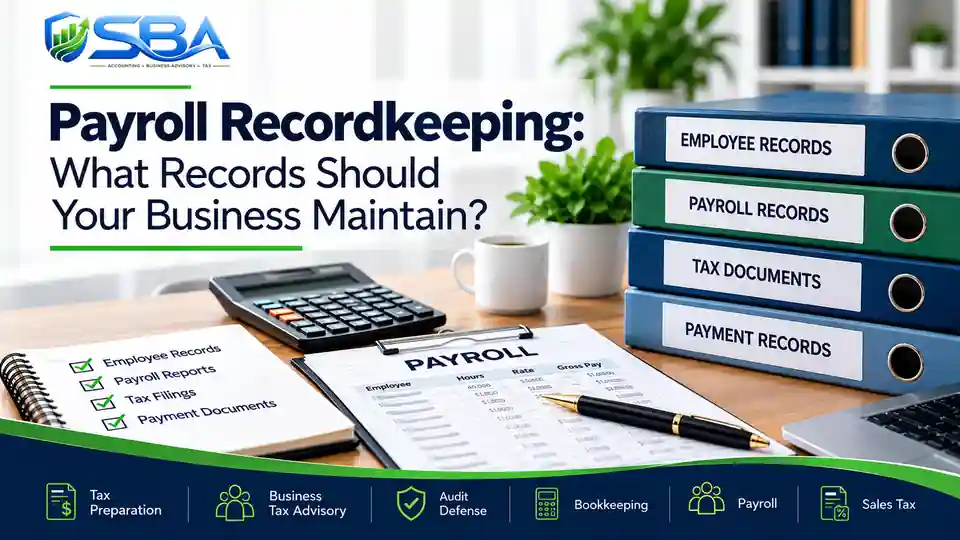
Payroll Recordkeeping: What Records Should Your Business Maintain?
A practical guide for small-business employers
Payroll recordkeeping helps small-business employers document hours worked, wages paid, deductions, tax deposits, and payroll filings. It also helps you answer employee questions, reconcile payroll with your books, and find supporting documents when needed.
However, each record type may have a different retention requirement. For that reason, a reliable payroll recordkeeping system should do more than store pay stubs in a folder. It should identify each record category, protect confidential information, and make documents easy to retrieve.
In This Guide
- What payroll records should you keep?
- How to organize payroll documents
- How long should records be retained?
- How to protect and review payroll records
- A practical payroll recordkeeping checklist
- Frequently asked questions and next steps
Key Takeaway
In practice, Accurate payroll records should connect employee information, time and wage calculations, payments, tax filings, and accounting entries. Moreover, retention periods vary by record type and applicable law, so employers should verify the rules rather than apply one blanket deadline.
1. What Is Payroll Recordkeeping and Why Does It Matter?
Payroll recordkeeping means creating, organizing, protecting, and retaining documents that support employee compensation and related payroll responsibilities. By maintaining these records consistently, you can explain how the business calculated wages, handled deductions, and met its reporting duties.
Additionally, These records explain how wages were calculated, what the business paid, which deductions the business applied, and how payroll taxes were reported or deposited. In addition, they can help you resolve discrepancies between payroll reports and accounting records.
For example, For covered employees, the U.S. Department of Labor identifies information such as hours worked, wage rates, overtime earnings, deductions, total wages, and payment dates among the records employers must maintain. See the Department of Labor’s FLSA recordkeeping guidance.
For that reason, make payroll recordkeeping part of your regular payroll process rather than postponing it until tax season.
2. Payroll Recordkeeping: Which Records Should Your Business Keep?
As a result, The exact documents depend on your workforce, payroll practices, and applicable federal, state, and local requirements. Even so, most employers can make payroll recordkeeping easier by organizing documents into several clear groups.
Payroll Recordkeeping: Employee Information and Tax Forms
First, maintain the employee information and forms needed to administer payroll properly. Depending on the employee and the rules that apply, this may include:
- Employee identification and contact information.
- Employment start dates and relevant employment-status records.
- Applicable federal and state withholding forms.
- Authorized deductions and relevant benefit information.
- Documentation of changes affecting pay or withholding.
Because these documents contain sensitive information, limit access to people who need them for legitimate business purposes. Also, review permissions whenever staff responsibilities change.
Payroll Recordkeeping: Time, Attendance, and Wage Calculations
Next, keep the records supporting how each employee’s compensation was calculated. These may include:
- Time sheets, time cards, or electronic timekeeping reports.
- Hours worked each day and each workweek, where required.
- Pay rates, salary arrangements, and applicable overtime calculations.
- Approved adjustments, bonuses, commissions, or other compensation.
- Records supporting additions to or deductions from wages.
For example, if an employee questions an overtime payment, the business should be able to trace the amount back to the hours, applicable pay rate, and calculation used. As a result, keeping supporting time and wage records is just as important as retaining the final pay statement.
Payroll registers, payments, and pay statements
In addition to calculation records, retain documents showing what the business actually paid. Depending on your process, these may include:
- Payroll registers and payroll summary reports.
- Pay statements or payroll-provider reports.
- Direct-deposit confirmations and other payment evidence.
- Records of corrections, voided payments, and reissued payments.
- Records showing the pay period and payment date.
At the same time, These documents provide a useful audit trail. If a payroll report does not match the amount withdrawn from the business bank account, you can compare the register, payment confirmation, and accounting entry to identify the difference.
Payroll Recordkeeping: Employment Tax Records and Filings
To make this easier, Payroll also creates tax responsibilities beyond employee payments. Consequently, maintain the records supporting applicable tax calculations, deposits, and filings.
- Copies of filed employment-tax returns.
- Tax-deposit confirmations and payment records.
- Wage statements and related year-end documentation.
- Payroll reports supporting amounts reported to tax agencies.
- Relevant correspondence and filing confirmations.
More importantly, The IRS recordkeeping guidance states that employment-tax records generally must be kept for at least four years. In addition, the IRS’s Employer’s Tax Guide, Publication 15, explains federal employer tax responsibilities and the records employers should retain.
In addition, Do not assume that saving a payroll provider’s monthly summary automatically preserves every document needed to support your filings. Instead, confirm which reports, source records, and confirmations your business can access and retain.
Practical Control
For this reason, At the end of each payroll cycle, save the final payroll register, supporting time and wage records, payment evidence, and relevant tax documentation. Then confirm that the files are accessible to authorized staff and can be matched to the accounting records.
3. Payroll Recordkeeping: How Long Should You Keep Records?
With that in mind, No single retention period applies safely to every payroll document. Therefore, check the requirement for each record category and build your schedule around the rules that apply to your business.
Consequently, Under the federal Fair Labor Standards Act (FLSA), the Department of Labor generally requires covered employers to retain payroll records for at least three years. Employers should generally retain records used to calculate wages—such as time cards, wage-rate tables, work schedules, and records of additions to or deductions from wages—for two years.
By comparison, Employment-tax records follow a separate federal rule: the IRS generally tells employers to keep them for at least four years. State requirements may also apply. For example, Virginia’s employment-unit recordkeeping regulation requires covered employers to preserve specified records for four years from the date of payment of the tax based on those records. Virginia law also addresses retention of employee pay statements.
In particular, The following table summarizes these examples; it is not a substitute for checking the rules applicable to your business.
| Record category | Example retention rule |
|---|---|
| FLSA payroll records | Generally at least 3 years |
| FLSA wage-calculation records | Generally 2 years |
| Federal employment-tax records | Generally at least 4 years |
| Certain Virginia employment-unit records | 4 years from the tax-payment date under the applicable regulation |
| Virginia employee pay statements | At least 3 years following the date the work was performed |
To avoid this problem, Sources: U.S. Department of Labor, IRS, and Virginia Administrative Code § 16VAC5-32-10.
Importantly, the applicable retention period can depend on the type of document, the law involved, and the circumstances. Therefore, create a retention schedule that accounts for all relevant requirements, including any longer period that applies to a particular record.
4. Payroll Recordkeeping: How to Organize Records Efficiently
As a practical step, A good filing system makes payroll documents easy to find while limiting access to authorized people. Fortunately, you can start with a simple structure and improve it as your business grows.
Payroll Recordkeeping Step 1: Create a Consistent Folder Structure
First, separate documents by record type and year. For example, your digital system might contain folders for employee forms, timekeeping, payroll registers, tax filings, payment confirmations, and year-end documents.
Even so, Within those folders, use consistent file names that identify the period and document type. However, avoid putting full Social Security numbers or other unnecessary sensitive details in file names.
Step 2 — Assign responsibility for each record
Next, identify who creates, reviews, saves, and retrieves each document. If a payroll provider processes payments, determine which records the provider stores and which your business must retain independently.
In addition, designate a backup contact or process so records remain accessible when the primary person is unavailable.
Step 3 — Protect confidential information
Beyond that, Payroll records contain personal details, wage information, withholding forms, and benefit-related documents. To protect that information, use access controls, strong authentication where available, secure file transfers, and protected backups.
In turn, Keep access limited to authorized users. Moreover, periodically review permissions and remove access when staff responsibilities change.
Payroll Recordkeeping Step 4: Reconcile Payroll with Bookkeeping
Therefore, After payroll is processed, compare payroll reports with the related bank activity and accounting entries. Check wages, employer payroll taxes, deductions, payments, and payroll-related liabilities.
For payroll recordkeeping, If a difference appears, investigate it rather than changing an entry simply to make the numbers agree. Document the correction and preserve the supporting records.
Likewise, For a broader view of how payroll fits into the accounting process, review SBA’s Small Business Payroll: A Beginner’s Guide and Small Business Bookkeeping: A Step-by-Step Beginner’s Guide.
5. Payroll Recordkeeping Mistakes Small Businesses Should Avoid
Afterward, Even a business with payroll software can have gaps in its records. Therefore, review your process for these common problems:
- Keeping only final pay statements. Retain the supporting time, wage, deduction, and payment records required for your business.
- Using one retention period for everything. Different laws and record categories can have different requirements.
- Leaving records with a provider without confirming access. Understand what your payroll provider retains and how you can retrieve it.
- Storing sensitive records in open folders. Limit access and protect backups.
- Failing to reconcile payroll. Compare payroll reports, payments, tax records, and accounting entries regularly.
- Overwriting corrections. Preserve an appropriate record of adjustments and their supporting documentation.
- Waiting until tax season to organize files. Save records consistently throughout the year.
Ultimately, the goal is not to collect documents without a plan. Rather, establish a repeatable process that keeps the right records complete, secure, and available for the required period.
Monthly Payroll Documentation Review
On the other hand, Use this quick review to spot gaps before they become harder to resolve.
- Confirm payroll registers are saved.
- Check that time and wage records are complete.
- Match payments to payroll reports.
- Confirm applicable tax filings and deposits are documented.
- Reconcile payroll activity with bookkeeping.
- Verify secure access and backup status.
- Check upcoming retention and filing deadlines.
6. Payroll Recordkeeping Checklist: What Small Businesses Should Review
That way, To put the process into practice, use this checklist when reviewing your current system.
Employee and wage records
- Employee information and applicable tax forms are maintained securely.
- Time and attendance information is complete where required.
- Pay rates, overtime, deductions, and adjustments are supported.
- Payroll registers and payment evidence are retained.
Tax and accounting records
- Applicable employment-tax returns and deposit confirmations are saved.
- Year-end wage statements and supporting documents are organized.
- Payroll-related bank activity is reconciled.
- Accounting entries agree with payroll reports, or differences are documented.
Retention and security
- A retention schedule identifies the rules applicable to each record category.
- Records are stored in a consistent structure.
- Access is restricted to authorized people.
- Backups are maintained and periodically tested.
- The process for retrieving provider-held records is understood.
For instance, As your business grows, revisit the checklist whenever you add employees, change payroll systems, operate in another jurisdiction, or change who manages payroll. In this way, your recordkeeping process can evolve with the business rather than becoming a source of confusion.
Frequently Asked Questions About Payroll
Which documents should a small business retain?
In many cases, Businesses commonly need employee information, time and wage records, payroll registers, payment evidence, applicable tax forms and filings, and supporting documentation. However, the exact requirements depend on the business, workforce, and applicable law.
How long should employers retain these documents?
Still, There is no universal period for every payroll document. For example, federal FLSA rules generally specify three years for payroll records and two years for records used to calculate wages, while IRS guidance generally requires employment-tax records to be kept for at least four years. State requirements may differ or add obligations.
Can employers store these documents electronically?
As noted above, Electronic storage can help when your business keeps records complete, accurate, secure, and accessible for the required period. In addition, maintain suitable backups and test whether you can retrieve records when needed.
If I use a payroll service, do I still need my own records?
To keep the process consistent, You should understand which records your provider maintains, which documents your business must retain, and how you can retrieve them. In addition, review payroll reports and keep appropriate evidence of payments, filings, and corrections.
How does organized payroll documentation support bookkeeping?
Meanwhile, Payroll creates wage expenses, tax liabilities, deductions, and payments that need to be recorded accurately. Consequently, organized payroll records help you reconcile accounting entries and maintain more reliable financial reports.
Keep Your Payroll Documentation Organized
Most importantly, Reliable payroll recordkeeping starts with a consistent routine: collect supporting documents, save them securely, reconcile the numbers, and apply the correct retention rules. Moreover, regular reviews help you find missing records before a filing deadline, employee question, or accounting discrepancy makes them urgent.
You do not need to build an overly complicated system. Instead, start with a clear folder structure, assigned responsibilities, secure access, and a documented retention schedule. Then review the process periodically as your business changes.
Need Help Managing Payroll?
SBA Accounting and Tax Services PLLC helps small businesses coordinate payroll, bookkeeping, and tax advisory needs. With a consistent process, you can keep payroll records organized and make recurring financial responsibilities easier to manage.
Explore our services
Payroll Services | Bookkeeping Services | Business Tax Advisory
Important: This article provides general educational information, not individualized legal, tax, or employment advice. Recordkeeping and retention requirements vary by record type, jurisdiction, and circumstances. Confirm current official guidance or consult a qualified professional before acting.




One Response