
Running a small business involves more than making sales and paying bills. Small business financial reports can help you understand what your financial information is telling you.
Small business financial reports provide an organized view of your company’s financial activity. They can help you understand profitability, financial position, and cash movement. However, each report answers a different question.
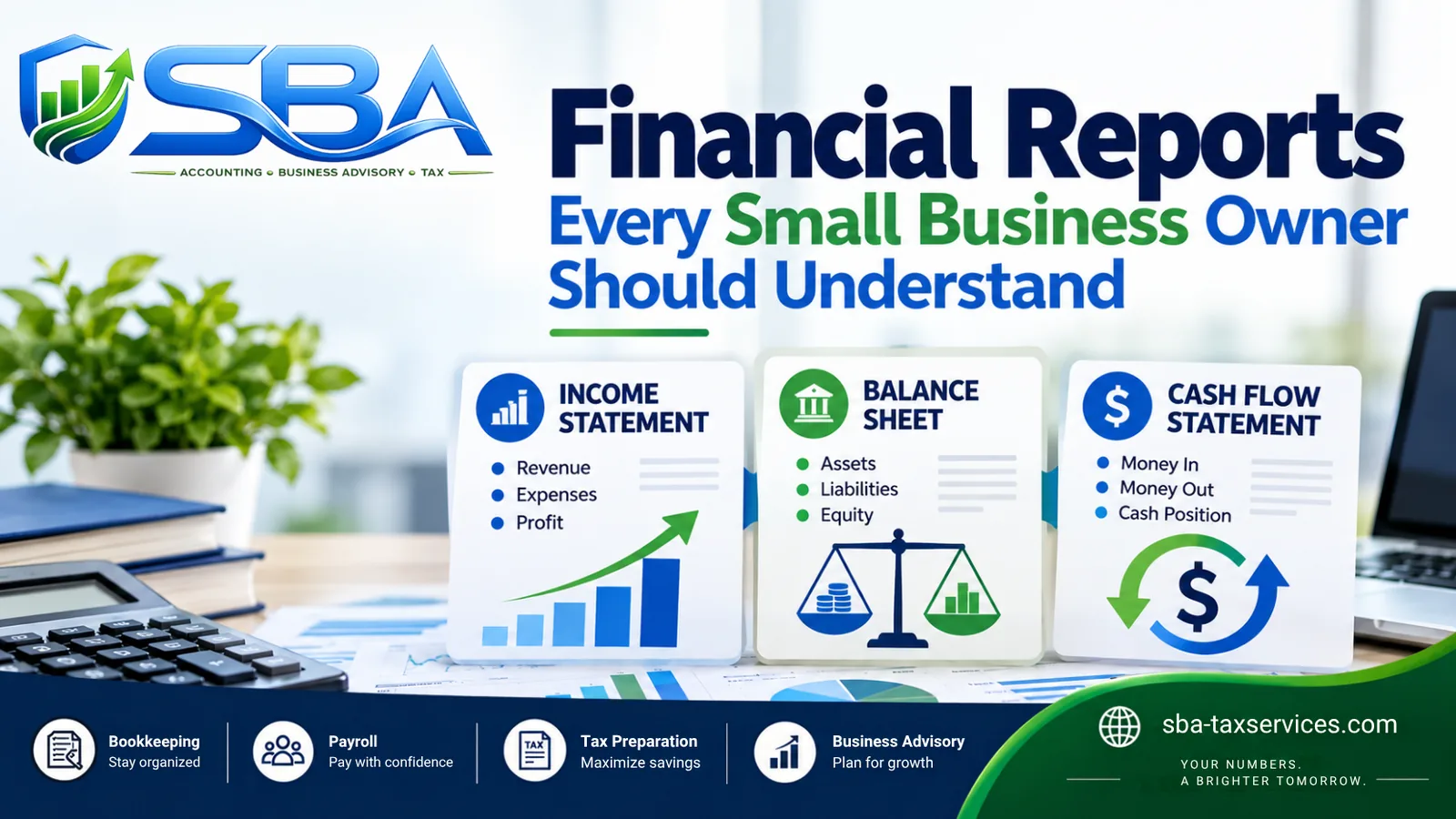
For example, an income statement can help you understand whether your business generated a profit over a specific period. A balance sheet provides a snapshot of what the business owns and owes at a particular date. Meanwhile, a cash flow statement focuses on how cash moved into and out of the business.
Therefore, learning how these reports work can make your financial information much easier to understand and use.
To begin, we’ll explain the three core financial reports, what each one tells you, how they differ, and how small business owners can use them together.
What Are Small Business Financial Reports?
Small business financial reports are organized summaries of a company’s financial activity and position.
They are generally prepared from the underlying accounting records maintained by the business. As a result, the quality of those reports depends heavily on accurate and organized bookkeeping.
In particular, the three core reports most business owners should understand are:
- Income Statement or Profit and Loss Statement
- Balance Sheet
- Cash Flow Statement
More importantly, each report looks at the business from a different perspective. Think of them as three connected views of the same business.
The income statement focuses on performance. The balance sheet focuses on financial position. The cash flow statement focuses on cash movement.
Taken together, these reports can provide a more complete picture than any single report by itself.
1. Income Statement: Are You Making a Profit?
The income statement, also called a Profit and Loss Statement or P&L, summarizes revenue and expenses over a specific period.
In simple terms, it helps answer: Did the business make or lose money during this period?
A basic income statement may include revenue, cost of goods sold when applicable, gross profit, operating expenses, other income or expenses, and net profit or loss.
For example, if a business generated $100,000 in revenue and incurred $75,000 in applicable costs and expenses, the resulting financial performance would reflect the difference between those amounts.
However, revenue by itself does not tell you how much the business actually earned after expenses. That’s why understanding the relationship between revenue, expenses, and profit matters.
For a deeper explanation, see our guide on Revenue vs. Profit: Key Differences for Small Businesses.
In addition, the income statement can help you compare performance between periods. For instance, you might compare one month with the previous month or compare the current quarter with the same quarter from the prior year.
What to Look For on an Income Statement
- Is revenue increasing or decreasing?
- Are expenses growing faster than revenue?
- Is gross profit changing?
- Which expenses represent the largest costs?
- Is net profit improving over time?
As a result, the income statement can help turn raw accounting data into a clearer view of business performance.
2. Balance Sheet: What Does Your Business Own and Owe?
The balance sheet provides a snapshot of the business’s financial position at a specific date.
In addition, it generally includes three major categories: assets, liabilities, and owner’s equity.
The basic accounting relationship is: Assets = Liabilities + Equity.
Assets
Assets are resources owned or controlled by the business. For example, depending on the business, these may include cash, accounts receivable, inventory, equipment, vehicles, property, and other business assets.
Liabilities
Liabilities represent amounts the business owes. Examples may include accounts payable, business loans, credit card balances, accrued expenses, and other financial obligations.
Equity
Equity generally represents the owner’s interest in the business after liabilities are considered.
For example, if a business has $250,000 in assets and $150,000 in liabilities, the remaining $100,000 represents the equity shown through the accounting equation.
Consequently, the balance sheet answers a different question from the income statement. Instead of asking whether the business was profitable during a period, you are looking at its financial position at a particular point in time.
The IRS explains that a balance sheet shows a business’s assets, liabilities, and equity on a given date.
3. Cash Flow Statement: Where Is the Cash Going?
A cash flow statement focuses on the movement of cash into and out of the business.
This is important because profit and cash are not necessarily the same thing.
For instance, a business can report a profit while experiencing cash pressure. Customers may owe the business money that has been recorded as revenue but has not yet been collected.
Likewise, a business may have cash available because it received financing even though that financing is not operating revenue.
More specifically, a cash flow statement generally organizes cash activity into operating, investing, and financing activities.
Operating Activities
These generally relate to the normal operations of the business. Examples can include cash received from customers and cash paid for operating expenses.
Investing Activities
These can include cash used to purchase or sell longer-term assets such as equipment.
Financing Activities
These can include certain borrowing, repayment, or owner-related financing transactions.
For a more detailed introduction, see our guide on Cash Flow for Small Businesses: A Practical Beginner’s Guide.
What to Look For
- Is the business generating cash from normal operations?
- Are large amounts of cash being used for equipment or other investments?
- Is the business relying heavily on financing?
- Are cash balances changing significantly?
- Are expected cash needs being planned for?
Therefore, cash flow reporting can provide information that may not be obvious from the income statement alone.
Small Business Financial Reports: P&L vs. Balance Sheet vs. Cash Flow
| Financial Report | Main Question | Primary Focus |
|---|---|---|
| Income Statement / P&L | Did the business make a profit or loss? | Revenue and expenses |
| Balance Sheet | What does the business own and owe? | Assets, liabilities, equity |
| Cash Flow Statement | Where did cash come from and where did it go? | Cash movement |
However, these reports should not be viewed as competing reports. Instead, they complement one another.
For example, the P&L may show that a business generated a profit. The balance sheet can then show its assets and liabilities, while the cash flow statement can help explain changes in available cash.
As a result, reviewing the reports together can provide more useful context than looking at one number in isolation.
Why Small Business Owners Should Review Small Business Financial Reports
1. Understand Business Performance
For example, financial reports can help you identify changes in revenue, expenses, profitability, assets, and liabilities. For instance, rising revenue may appear positive, but increasing expenses could change the overall financial picture.
2. Monitor Cash Position
Cash flow information can help you understand whether cash is coming into the business at a pace that supports ongoing obligations. This is particularly important when customer payments, payroll, vendor bills, loan payments, and other cash requirements occur at different times.
3. Identify Financial Trends
Reviewing reports regularly can make changes easier to spot. You might notice increasing operating expenses, declining margins, growing accounts receivable, rising debt, or changing cash balances.
Consequently, regular reporting can help you investigate changes before they become larger issues.
4. Support Financial Planning
Financial reports can also provide information for budgeting and planning. For instance, historical income and expenses can help provide a starting point for future projections.
The U.S. Small Business Administration also highlights the importance of understanding the income statement, balance sheet, and cash flow statement when using financial information for planning and funding purposes.
5. Prepare for Conversations With Financial Professionals
Accurate reports can also make conversations with accountants, lenders, advisors, and other financial professionals more productive. Instead of discussing the business only in general terms, you can review specific financial information together.
How Bookkeeping Supports Small Business Financial Reports
Financial reports do not appear automatically. They depend on the underlying accounting records.
That means transactions such as sales, expenses, payroll, purchases, payments, and other business activity need to be recorded accurately and consistently.
The IRS guidance on recordkeeping explains that business transactions generate supporting documents and that those records provide information used in the business books.
For example, accurate bookkeeping helps organize revenue, expenses, accounts receivable, accounts payable, assets, liabilities, payroll, and owner transactions.
When these records are incomplete or incorrectly categorized, the resulting financial reports may not provide a reliable picture of the business.
For additional context, see 7 Financial Numbers Every Small Business Owner Should Track.
How Often Should You Review Financial Reports?
There is no single review schedule that fits every business. However, many small businesses benefit from reviewing financial information regularly rather than waiting until the end of the year.
Monthly
- Revenue
- Expenses
- Net profit or loss
- Cash position
- Major changes from the previous month
Quarterly
- Revenue trends
- Profitability
- Cash flow
- Outstanding receivables
- Debt
- Major expense changes
Annually
- Overall performance
- Major changes
- Business expenses
- Cash trends
- Planning assumptions
- Upcoming financial needs
Ultimately, the appropriate frequency can depend on the size, complexity, and needs of the business. The important point is consistency.
A Simple Financial Report Review Process
You do not need to be an accountant to begin asking useful questions about your reports.
Try this five-step process.
Step 1: Review Revenue
First, start by looking at revenue and comparing it with previous periods.
Step 2: Review Expenses
Next, identify major expenses and changes from prior periods.
Step 3: Review Profitability
Then, look at gross profit and net profit where applicable.
Step 4: Review Financial Position
Afterward, review assets, liabilities, and equity on the balance sheet.
Step 5: Review Cash Movement
Finally, look at cash inflows and outflows and identify significant changes.
This process can help you connect the three reports instead of reviewing each one separately.
Common Mistakes When Reading Financial Reports
Mistake 1: Looking Only at Revenue
High revenue does not automatically mean high profitability.
Mistake 2: Treating Profit as Cash
Profit and cash flow measure different aspects of the business.
Mistake 3: Reviewing Only Once a Year
Waiting too long can make it harder to identify developing trends.
Mistake 4: Ignoring the Balance Sheet
A business can have strong sales while carrying significant liabilities or having limited working capital.
Mistake 5: Focusing on One Number
A single number rarely tells the entire story. Instead, review related figures across the income statement, balance sheet, and cash flow statement.
Financial Reports Starter Checklist
- Review revenue
- Review major expenses
- Check gross profit where applicable
- Review net profit or loss
- Review cash balances
- Review accounts receivable
- Review accounts payable
- Review assets
- Review liabilities
- Review owner’s equity
- Compare current results with previous periods
- Investigate significant changes
- Update your financial plan when needed
Good recordkeeping provides the foundation for these reports. The IRS notes that good records help businesses monitor progress, prepare financial statements, track expenses, and support information reported on tax returns.
FAQs About Small Business Financial Reports
What are the three main financial reports for a small business?
The three core reports are generally the income statement or P&L, balance sheet, and cash flow statement. Each provides a different view of business finances.
What does an income statement tell a business owner?
An income statement summarizes revenue and expenses over a specific period and shows the resulting profit or loss.
What does a balance sheet show?
A balance sheet provides a snapshot of assets, liabilities, and equity at a specific date.
Why is a cash flow statement important?
A cash flow statement shows how cash moves into and out of the business and can provide information that is different from profitability.
How often should small business owners review financial reports?
Many businesses benefit from reviewing financial information regularly, often monthly, with more detailed quarterly and annual reviews as appropriate.
Can bookkeeping affect financial reports?
Yes. Financial reports are based on accounting records. Therefore, incomplete, inaccurate, or incorrectly categorized transactions can affect the information shown in the reports.
Final Thoughts: Understand Your Numbers
Financial reports are more than accounting documents.
They can help you understand what happened in your business, where your money is going, what you currently own and owe, and how your financial position is changing.
The income statement helps you understand performance. The balance sheet helps you understand financial position. The cash flow statement helps you understand cash movement.
When you review these reports together, you can develop a clearer picture of your business finances.
Most importantly, accurate reporting starts with accurate records. By maintaining consistent bookkeeping and reviewing your financial information regularly, you can make your numbers easier to understand and use.
Numbers Today, A Brighter Tomorrow.
Need Help Understanding Your Business Numbers?
SBA Accounting and Tax Services PLLC helps small businesses maintain organized financial records and understand the information behind their numbers.
Explore our bookkeeping and accounting services or contact SBA Accounting and Tax Services PLLC to discuss your business needs.




6 Responses